Our store has been restocked! Free enamel pin with orders of $30 or more (before shipping)

Want to see your library story in a comic? Email it to Gene! If we use yours you get a free print.

Library Comic is published two days a week, Monday and Wednesday. Book reviews Tuesday and Thursday.

We recommend you also read The Haunted Skull by Willow Payne and Gene’s friend’s Tim Allen Stories .


Graphic Novel Review: Drawn & Quarterly: Twenty-five Years of Contemporary Cartooning, Comics, and Graphic Novels

Drawn & Quarterly: Twenty-five Years of Contemporary Cartooning, Comics, and Graphic Novels edited by Tom Devlin with Chris Oliveros, Peggy Burns, Tracy Hurren, and Julia Pohl-Miranda. Translations by Helge Dascher. Drawn & Quarterly, 2015. 9781770461994. 776pp. If you’re looking for a comics anthology to brighten your involuntary days at home or a book to introduce you to a wide range of independent creators with bodies of work you can start reading NOW, look no further. In fact, you’ll probably love the front cover and spine (plus front endpapers) by Tom Gauld. He and Pascal Girard, whose work can also be found inside, draw the best bookstores and libraries. The book opens with a section on the history of Drawn & Quarterly that includes old photos featuring questionable haircuts of famed comics creators that will make you laugh, particularly if you frequent the better sections of comic conventions. Then it’s comics, lots of excellent comics! Alongside and among are reminiscences, tributes, and appreciations of the publishing personalities and the talent, my favorites being the one of Seth by Lemony Snicket and Aaron Cometbus’ essay about John Porcellino. You don’t have to read everything, you don’t even have to read it in any order, and it’s so diverse in tone and style you probably won’t love it all, but there’s so much great work inside that it won’t matter. Depending on how widely you read, it’s full of amazing comics by everyone you’ve heard of (if you already have great taste) or amazing comics from all of the indy creators you’re about to discover (GET YOUR HANDS ON A COPY NOW!). D&Q has introduced me to so many artists whose work I love: Doug Wright, Adriane Tomine, Michel Rabagliati, Lynda Barry, John Porcellino, Guy Delisle, Tove Jansson, Brecht Evens, Jillian Tamaki, and more. And there were a few folks I’d never heard of; how is it I’d never seen a comic by Diane Obomsawin (aka Obom)? I loved the deadpan Greek mythology by her so much (it starts with Zeus seducing Callisto) that I ordered everything by her that’s available. And because I’ve heard that kettle bells are sold out all over the US, I want to point out that at 776 pages you can probably use this anthology as a weight for a variety of exercises.

Graphic Novel Review: Crows: Genius Birds (Science Comics) by Kyla Vandreklugt

Crows: Genius Birds (Science Comics) by Kyla Vandreklugt. First Second, 2020. 9781626728028. 122pp. including a glossary, a short comic on living with crows, and a list of books and articles on crows. This graphic novel in First Second’s Science Comics series grabbed my interest from the beginning — six crows team up to get Buddy, a very happy and gullible dog, out of his yard, and then use tools to open his dog door to get access to his food. As Buddy and his American crow “friend” head out into the world together, the crow explains the family Corvidae and how relatively big and neuron-dense crows’ brains are. As they continue to explore, it explains the superiority of crows with both scientific and real-world examples. It’s nicely done and the illustrations (which include some cartoonish medical diagrams and the like) really seem to be part of the conversation. I have to admit that part of the reason I loved this book so much is personal. Every year, the crows in my neighborhood dive-bomb my wife but not me. (Years ago and miles away, this problem started when she got too close to a fledgling crow in our yard. I already knew that crows can remember individuals and communicate with one another about them, but that’s covered nicely in this book, too.) Plus this is a great readalike for Kira Jane Buxton’s Hollow Kingdom, a funny, apocalyptic novel set partially in my neighborhood in Seattle, narrated by a very smart-assed crow who is trying to save a very dumb dog from being eaten.  

Fiction Review: Ashes of the Sun by Django Wexler

Ashes of the Sun (Burningblade and Silvereye Book 1) by Django Wexler. Orbit, 2020. 9780316519540. 592pp. The Chosen ruled humanity, but after an apocalyptic war with the underground-dwelling ghouls, they’re both gone. Now the Centarchs of the Twilight Order maintain some of the Chosen arcana and use it, along with their inborn power, the deiat, to defend the Dawn Republic. Mostly they fight the plagueborn — twisted creatures created from heaps of spare flesh — and the dhakim, cultists who use dark, forbidden arcana. It’s a little light side vs. dark side, complete with amazingly cool sabers called haken, whose form depends on the nature of the wielder’s deiat. (Wexler, in the acknowledgements, says the book “originated in a series of conversations about Star Wars.” It’s much more than the swords, but this book is not a knockoff.) At the heart of it all is Maya, a young woman on the verge of becoming a Centarch, serving under a very kind master. Maya was taken from her family at a young age after her power was identified, a moment she doesn’t remember or dwell on. But her brother Gyre remembers — he tried to stop her from being taken and paid a high price. Now Gyre wants nothing more than to find a way to bring an end to the Twilight Order. To do that he needs to find a weapon to stand up to the Centarchs and the deiat. This will, of course, bring him into direct conflict with his long-lost sister. The world is full of automatons, monsters, crashed skyships, and the remnants of past civilizations. Of special interest to librarians, Maya even has a budding romance with a young archivist! By the end of the book it’s clear — because we have characters to root for on both sides — that the basic idea of good and bad, Chosen vs ghouls, is more complicated than it seems. I’m really looking forward to the sequel(s).

Graphic Novel Review: Sunken Tower by Tait Howard

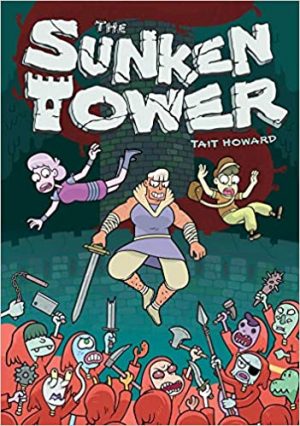
Sunken Tower by Tait Howard. Oni Press, 2020. 9781620106877. 132pp. Dig is kidnapped by some red-robed cultists who throw him into an underground dungeon. The women in the next cell, Iana and Crina, tell him the tale of an inexperienced wizard who lost control of blood magic, sinking the tower and the city around it. He became a monster, and the cultists intend to sacrifice the three prisoners to it. (Iana then hands Dig a brochure. This is a fairly lighthearted, funny adventure, unless you’re a blood cultist.) It’s not long before the three have escaped their cells and retrieved Dig’s book of magic. Their plan: find the castle in the middle of the sunken city and climb to the top floor so that Dig can use his magic to blast them out. But all does not (of course) go according to plan. Many cultists die in very horrid ways, which would be horrific if this weren’t so damned cartoony and cute. There are thorny tentacles, fish people, and that giant monster. Dig’s magic isn’t all that (but it is). Fun book.

Graphic Novel Review: Unrig: How To Fix Our Broken Democracy (World Citizen Comics)

Unrig: How To Fix Our Broken Democracy (World Citizen Comics) by Daniel G. Newman, art by George O’Connor. First Second, 2020. 9781250295309. 280pp. including notes/citations for each chapter and an index. Newman, who runs MapLight (maplight.org), lays out problems with our political system alongside examples of how they can and are being fixed. At the heart of most of the trouble is money, wielded by companies and individuals who can spend enough to determine who runs for office, gets elected, and writes US laws. The politicians they help elect then rig the rules in their own favor, and to favor the folks who help get them elected. Newman points to ways to unrig the system, including Seattle’s democracy voucher program, which allows candidates to fund campaigns without becoming beholden to those who finance their campaigns. (He highlights other ideas for clean elections too, which not only affect funding but also make politicians pay attention to the public as a whole.) The book often goes into a great deal of detail — for the Seattle idea, for example, Newman talks about how it came to be starting with the ten folks who founded Vote Clean Seattle, and how they pushed their idea forward, including what they learned from early mistakes. Not to make a huge push for this, but this whole section at the beginning pretty much guarantees every library I frequent in Seattle and King County (the county around Seattle) is going to buy a few copies — and they should. But it doesn’t just belong here, it belongs everywhere. There are other real-life examples from across the country as Newman looks at problems with congress, the most shocking of which is how much time each member has to spend making calls to solicit donations for their next campaign. (This clearly has to be their focus, with the way things are now and the amount of money they have to raise: “The average winning Senate candidate spent much more — $15.8 million. That’s more than $7,000 per day — for an entire six year term.”) At the heart of most problems Newman lays out, is MONEY. He explores campaign finance rules in detail, shows how wealth hoarders buy a system that benefits them (including climate change denial), and addresses voter suppression. In each case though he offers hope and a way forward. There’s much more in the book than I’m detailing, too. I normally don’t like graphic novels with a talking head, and it’s worth noting that Newman himself appears in this one throughout, talking to readers. But O’Connor (best known for his Olympians graphic novels) has done a fantastic job illustrating the concepts and people Newman discusses, and the panel layouts, word balloons, and other text work together to keep make the book a page turner.

Graphic Novel Review: Kusama The Graphic Novel by Elisa Macellari

Kusama The Graphic Novel by Elisa Macellari, translated from Italian by Edward Fortes. Laurence King, 2020. 9781786277169. 128pp. Lenz’s documentary Kusama – Infinity, and Kusama’s autobiography Infinity Net are the two main sources listed at the back of the book, but even if you’re familiar with both there’s a lot to love in Macellari’s colorful, well-designed graphic novel. (Is it weird that my favorite part of the book is Kusama’s deadpan face and the way Macellari draws Kusama at different ages?) The book opens with Kusama’s early life, including her unsupportive mother and going inside her head a bit to show her mental illness and obsessions. Kusama moves to New York in the late 1950s and works on art around the clock, anxious and detached. She’s driven and ambitious, and has quite a bit of success. (The book spends a few pages on her intense and platonic relationship with artist Joseph Cornell, which is lovely and sad.) After she returned to Japan because of her mental health, there was a period where she was mostly forgotten, though now, of course, she’s become famous worldwide for her art and for being herself. (If you haven’t ever experienced one of her mirrored infinity rooms and you have the chance, go for it.) This looks like a friendly, colorful book for kids, but it’s probably not something most parents would appreciate finding in the children’s graphic novel section of the library — Kusama witnesses her father cheating on her mother, and there’s some nudity when she’s creating public performance art in New York. Worth noting: it’s all tastefully drawn (even the adultery).

Graphic Novel Review: InvestiGators by John Patrick Green

InvestiGators by John Patrick Green. First Second, 2020. 9781250219954. 201pp. including a few lessons in how to draw characters in the back. Investigators is the graphic novel Green has been working toward for years. It brings together the cute animals and workplace humor of his Kitten Construction Company and Hippopotamister in a fun, wordplay-filled mystery featuring two alligator investigators, Mango and Brash. The pair work for S.U.I.T. (Special Undercover Investigative Teams) to solve mysteries and fight “crime, corruption, and confusion.” The story starts with the pair going undercover at a bakery because world famous cupcake chef Gustavo Mustachio is missing, which leads them to another mystery involving the thingamabob invented at the Science Factory and the villain who wants to steal it. Oh and there’s also a shadowy, vaguely alligator-shaped figure forcing Gustavo to bake for his nefarious reasons (which will come into play in the sequel, which was just published). My favorite thing about the book, aside from the drawings, is a character straight out of Green and Dave Roman’s Teen Boat!, a transforming doctor with a hilarious origin story and a very strange trigger word.

Graphic Novel Review: Aster of Pan by Merwan

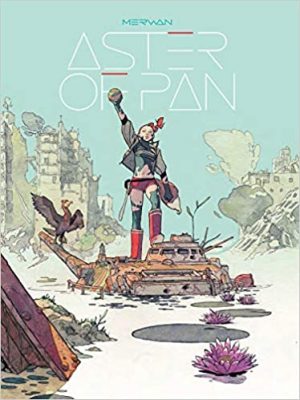
Aster of Pan Volume 1 by Merwan. Translation: M.B. Valente. Originally published by Dargaud, 2019. 9781942367949 (the 2021 English translation). 200pp. Info at http://www.europecomics.com/album/aster-pan-v1/ though it looks like the digital versions have been pulled from the US market because a print edition by Magnetic Press is coming in Nov. 2020. That book will contains this and Volume 2. February, 2068, Fontainebleau Forest. Aster lives alone in a treehouse, surviving on what she can scavenge from the ruins of Paris and trade for in Pan, the farm town where her book-loving friend Wallis lives. Aster is all big gestures and toughness, though it’s clear she wants a family and longs to be a citizen of Pan. There’s a bear, a pirate attack, and a bit of politics before an “ambassador” arrives with tech and soldiers from the Republic of Fortuna, announcing that Pan will soon have the honor of joining their federation. The leaders of Pan aren’t happy, but they have little choice. But then they ask for arbitration by celestial mechanics. (No one even knows what that means.) But then someone arrives in Pan who starts training them for the game they’ll have to play. It’s more than a little ridiculous, but also serious, and of course they need Aster to completes their team (even though she’s un-Pan). The story has the perfect amount of fun for its post-apocalyptic setting, and I really loved Merwan’s drawings. Their fluidity reminds me of the best of Connor Willumsen’s, though there’s also a bit of a manga influence in the body language and facial expressions, and it’s perfect colors hold the words and art together. Assuming Volume 2 is as good, the forthcoming book would be a great graphic novel for any YA or adult collection.

Graphic Novel Review: Banned Book Club by Hyun Sook Kim and Ryan Estrada, illustrated by Hyung-Ju Ko

Banned Book Club by Hyun Sook Kim and Ryan Estrada, illustrated by Hyung-Ju Ko. Iron Circus Comics, 2020. 9781945820427. 192pp. This fictionalized memoir of Kim Hyun Sook’s life begins in 1983. It was the year she started college, and back then the US backed South Korea’s ruling military dictatorship. College campuses were the sites of protests that often turned violent. The government sometimes tried to silence students with violence and disappearances. Her first day at Anjeon University, Hyun Sook has to dodge Molotov cocktails, tear gas, and riot police to get through the main gate to her first class. She soon joins a masked folk dance club to stay out of politics, but even traditional dances are political. One of her new friends invites her to a book club, which sounds great. But she soon finds out the attendees read and discuss books that could get them arrested. At first Hyun Sook decides not to join. Bu her Shakespeare professor indirectly encourages her, and soon she’s attending. She learns a lot, including about the parts of her country’s history that her parents don’t talk about like the Kwangju Massacre. Soon a government agent is after them. is trying to track down members of the book club. It’s all very a bit harrowing, but there are also lighthearted moments. The opening scene in Hyun Sook’s parents’ steak restaurant made me laugh, and so did the movie everyone is talking about (it involves a naked woman on a horse). Some book club members even copy books right under the nose of a government censor. The characters are all easy to root for, especially for library folk and readers like us. Hyung-Ju Ko’s expressive illustrations make them even more likable. This biography is fictionalized, in part to protect the people in the story, as Kim says in her biographical statement. But it rings true to me based on stories my wife has told me about her university days in Busan, where Kim and Estrada currently live.

Nonfiction Review: Arabian Sands by Wilfred Thesiger

Arabian Sands by Wilfred Thesiger. Penguin Classics, 2008. 9780141442075. 347pp. including photographs and an index. “Arabian Sands describes the journeys I made in and around the Empty Quarter from 1945 to 1950, at which time much of that region had not yet been seen by a European.” (The Empty Quarter is a huge dessert in the southern part of the Arabian Peninsula.) Thesiger’s detailed account is full of vivid descriptions and immense hardship, as well as respect for and camaraderie with his Bedu companions. I loved the hospitality displayed by most who met Thesiger, though he did face danger from a few who were displeased with having a Christian in their land. There’s also a sadness around the edges of the journey — the oil companies are moving in and making deals, and Thesiger can see that the Bedu’s way of life won’t last much longer. This is one of my friend Mac’s favorite books. When he read a passage from it at Christmas dinner last year, he could see that I was hooked, and he loaned me a copy. (He keeps several around the house.) When I finished it I had an intense desire to wander around in the dry heat and an aversion to riding camels (though I might try eating one if it’s ever an offer). You can see some amazing photos by Thesiger from this time period here.