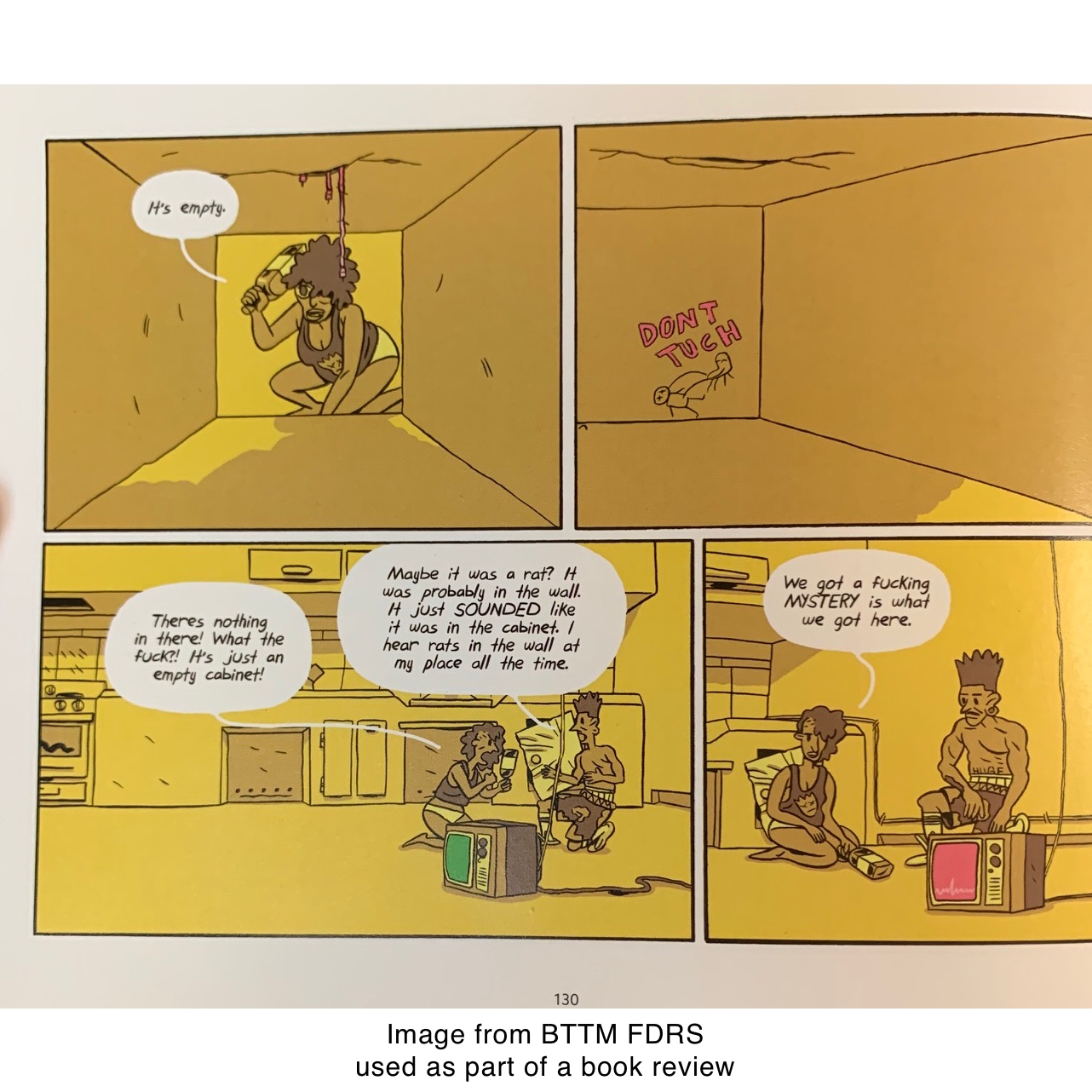

Waiter Rant: Thanks for the Tip- Confessions of a Cynical Waiter by The Waiter (Steve Dublanica). (He was anonymous initially, but later editions revealed his name at the end of the book, and now it’s on the cover.) 9780061256684. Harper Collins, 2008. 302pp.
The Waiter who wrote this book didn’t plan to wait tables. The pace, the idea of taking home cash every night, and the lack of other job prospects in a slow economy kept him at The Bistro. The whole time he bemoaned his job — all he really wanted was to spend more time on this book.
The chapter “Heaven and Hell” is one that anyone who works with the public will be able to understand, and my favorite. The Waiter recounts the time he had a shitty week — he was tired and cranky from working all the time and the tips were barely covering his bills. He was once again thinking about throwing in his apron and getting a “real” job. An affluent young family brought his attention to the homeless man who camped out near The Bistro. The Waiter’s heart grew three sizes (much like the Grinch’s) when the family bought dinner for the homeless man. After the Waiter took him his dinner, the man commented, “Sartre was only half right. People can be Heaven, too.” But the public can be a weird, needy group, too — sometimes they will curse out their server if their eggs were cooked over-medium instead of over-well, and the after-church crowd may leave servers religious tracts instead of money.
Like the Waiter, I never ever spit in anyone’s food while I was on the job, but I did enjoy making certain condescending jerks sweat. I had one guy who would repeatedly come in at lunch, never get off his cell phone, and would always shoo me away when I tried to take his order. On the third day of Mr. Businessman’s rude behavior, I ignored the boorish way he waved me over while still on his phone and came to his table last. I had already taken everyone else in my section’s orders; some were already eating. He was the last person left in my section and was pretty miffed. I told him sweetly, “You always looked so busy when you come in that I didn’t want to interrupt you. Would you like to hear today’s specials?” And there was a guy who literally growled at me when I tried to take away his menu. I told him, “Don’t growl at me, dude, I see your food before you do!” He laughed out loud and became one of my regulars. I called him “Growly” although he insisted his mother named him Dave.
The tips I earned as a waitress put me through school — I never had to take out a student loan. It’s hard to explain the adrenaline rush of waiting tables to someone who has never done it, but the waiter really shows that it’s a bit like performing a one-person show where anyone in the “theater” (fellow wait staff, cooks, bartenders, bus people, customers, etc.) can ruin your night. Everyone on this planet should wait tables for at least six months. If you decide to take up the challenge, you will appreciate the long hours on your feet (instant calf muscles), the dedication of the kitchen crews who are usually there before sunrise and can’t leave until after closing, and the way your ability to memorize while multi-tasking will improve, because you’ll want to get paid for the experience, right? You may discover hidden talents and the ability to thrive in chaos. At worst, after the experience you will never tip less than 20 percent again.
Thanks to Murphysmom for this guest book review!

Latest Comics
-
#1344. twelve hundred fifty four
Feb 04, 2026
-
#1343. twelve hundred fifty three
Feb 02, 2026
-
#1342. twelve hundred fifty two
Jan 28, 2026
-
#1341. twelve hundred fifty one
Jan 26, 2026
-
#1340. twelve hundred fifty
Jan 21, 2026
-
#1339. twelve hundred forty nine
Jan 19, 2026
-
#1338. twelve hundred forty eight
Jan 14, 2026
-
#1337. twelve hundred forty seven
Jan 12, 2026
-
#1336. twelve hundred forty six
Jan 07, 2026
-
#1335. twelve hundred forty five
Jan 05, 2026
Guest Book Review: Waiter Rant
Waiter Rant: Thanks for the Tip- Confessions of a Cynical Waiter by The Waiter (Steve Dublanica). (He was anonymous initially, but later editions revealed his name at the end of the book, and now it’s on the cover.) 9780061256684. Harper Collins, 2008. 302pp.
The Waiter who wrote this book didn’t plan to wait tables. The pace, the idea of taking home cash every night, and the lack of other job prospects in a slow economy kept him at The Bistro. The whole time he bemoaned his job — all he really wanted was to spend more time on this book.
The chapter “Heaven and Hell” is one that anyone who works with the public will be able to understand, and my favorite. The Waiter recounts the time he had a shitty week — he was tired and cranky from working all the time and the tips were barely covering his bills. He was once again thinking about throwing in his apron and getting a “real” job. An affluent young family brought his attention to the homeless man who camped out near The Bistro. The Waiter’s heart grew three sizes (much like the Grinch’s) when the family bought dinner for the homeless man. After the Waiter took him his dinner, the man commented, “Sartre was only half right. People can be Heaven, too.” But the public can be a weird, needy group, too — sometimes they will curse out their server if their eggs were cooked over-medium instead of over-well, and the after-church crowd may leave servers religious tracts instead of money.
Like the Waiter, I never ever spit in anyone’s food while I was on the job, but I did enjoy making certain condescending jerks sweat. I had one guy who would repeatedly come in at lunch, never get off his cell phone, and would always shoo me away when I tried to take his order. On the third day of Mr. Businessman’s rude behavior, I ignored the boorish way he waved me over while still on his phone and came to his table last. I had already taken everyone else in my section’s orders; some were already eating. He was the last person left in my section and was pretty miffed. I told him sweetly, “You always looked so busy when you come in that I didn’t want to interrupt you. Would you like to hear today’s specials?” And there was a guy who literally growled at me when I tried to take away his menu. I told him, “Don’t growl at me, dude, I see your food before you do!” He laughed out loud and became one of my regulars. I called him “Growly” although he insisted his mother named him Dave.
The tips I earned as a waitress put me through school — I never had to take out a student loan. It’s hard to explain the adrenaline rush of waiting tables to someone who has never done it, but the waiter really shows that it’s a bit like performing a one-person show where anyone in the “theater” (fellow wait staff, cooks, bartenders, bus people, customers, etc.) can ruin your night. Everyone on this planet should wait tables for at least six months. If you decide to take up the challenge, you will appreciate the long hours on your feet (instant calf muscles), the dedication of the kitchen crews who are usually there before sunrise and can’t leave until after closing, and the way your ability to memorize while multi-tasking will improve, because you’ll want to get paid for the experience, right? You may discover hidden talents and the ability to thrive in chaos. At worst, after the experience you will never tip less than 20 percent again.
Thanks to Murphysmom for this guest book review! Graphic Novel Review: Stanislaw Lem’s The Seventh Voyage: A Graphic Novel by Jon Muth
Stanislaw Lem’s The Seventh Voyage: A Graphic Novel by Jon Muth. Scholastic Graphix, 2019. 9780545004626. 80pp.
Ijon Tichy is cruising in the vicinity of Betelgeuse, when his ship is hit by a small meteoroid. He suits up and goes outside to make repairs, but it’s impossible to do alone. His ship flies on, straight ahead, its velocity increasing. After a failed meal that he turns into a satellite around his ship, Tichy goes to bed, and is awoken by a version of himself from the future who wants to help with the repairs. He refuses to believe his future self was real, but he’s wrong — it’s the beginning of an absurd and comical time travel adventure.
Jon Muth’s watercolors make this graphic adaptation of one of Lem’s Ijon Tichy stories even more lighthearted than it already is — when Tichy’s ship is struck in the first pages, he’s baking. And later the Tichy’s from different days and ties crowd the ship, the art is just amazing, and really silly. This is a great introduction to Lem’s fiction for young readers, and it’s going to make old fans like me smile, too.
I fell in love with Lem’s stories reading One Human Minute because it showed me a direction I’d never considered, that science fiction could include reviews of books that don’t exist. Lem’s work is brilliant. Thanks to Muth for pointing me back in Lem’s direction.
You can read the original story (and others by Lem) at https://english.lem.pl/works/novels/the-star-diaries/154-the-seventh-voyage
Graphic Novel Review: This Was Our Pact by Ryan Andrews
This Was Our Pact by Ryan Andrews. First Second, 2019. 9781626720534. 330pp.
On the night of the Equinox Festival, Ben and four friends make a pact to follow the lanterns down the river. Do they really become stars? They promise to ride their bikes for as long as it takes to find out. But then Nathaniel starts following them (his dad and Ben’s dad are best friends). One by one, Ben’s friends drop out and head for home until only he and Nathaniel are left. (Nathaniel is a bit of an outsider, and Ben’s friends are promise-breaking jerks, so this is clearly for the best.) They meet a bear on his way to catch fish, who thinks the lanterns are fish, and who wishes he could join them as they swim among the stars. They separate at a towering cliff the boys cannot climb. The boys do figure out a way forward, and of course they meet the bear again, but giving more details would be telling.
This graphic novel combines the quiet magic of the best Miyazaki movies with a beautiful visual style all of its own. I cannot imagine anyone who wouldn’t enjoy the quest, and seeing Ben and Nathan’s friendship form is just as magical.
Graphic Novel Review: Sunny Rolls the Dice
Sunny Rolls the Dice by Jennifer L. Holm & Matthew Holm. Scholastic Graphix, 2019. 9781338233155. 224pp.
This is the third of the semi-autobiographical Sunny graphic novels from the siblings Holm, and it’s by far my favorite.
1977, Pennsylvania. Sunny is becoming obsessed with teen culture, in particular with magazines that rate her on the groovy meter and from which, after taking a quiz, she knows she is “not groovy.” She also loves comics and Dungeons & Dragons, which she starts playing with friends. (Her human fighter’s name is Aleta the Brave.) At some point her desire to be groovy leads her to stop playing D&D which makes her unhappy (at least until she figures out that that was a bad move).
I think older grade school aged kids will love this book, but since I grew up in the 70s, this is pure nostalgia for me: bugbears, gelatinous cubes, off-brand action figures, roller skating, and pining for my very own Monster Manual. (I never got one, but Jennifer Holm apparently did.)

Graphic Novel Review: Queen of the Sea
Queen of the Sea by Dylan Meconis. Walker Books (Candlewick), 2019. 9781536204988. 394pp.
Young Margaret lives on a small island in the Silver Sea, in a convent that belongs to the Elysian Order. She’s not sure where she was born, why she came to the island, or who her parents are, but she’s reassured by the nuns that she was sent there to be safe. Envious of kids who have parents, she bonds with the only “children” on the island: the wooden statue of the Sorrowful Child, and Eleanor, who is in a painting with her father, King Edmund. Margaret’s prayers are answered when the supply ship brings William and his overprotective mother, Lady Cameron. They’ve been exiled to the island after William’s father rebelled against the king. Margaret and William become close, and, years later, when he finally decides to leave the island, he’s the one that gets her to see that everyone there, including her, is a prisoner and cannot leave. Soon after a new exile arrives, and it is Eleanor (from the painting), along with guards and a very strict, high ranking nun. Eleanor is a bit angry (in part because she’s been exiled by her sister, who seized the throne), but Margaret is desperate to become friends, and soon finds herself drawn into helping Eleanor.
This book is based on events in the British Isles in the 16th Century. I cannot imagine being excited about a book that meets that description if it were written/drawn by anyone else, but I’ve been a fan of Meconis’ comics since reading Family Man years ago, and the characters, the writing, and art all drew me in. I found myself rooting for Margaret, and also fascinated by the details of convent life, from the coracle they used for fishing to the hours of the day to the hand signs they communicated with while eating silently.
This is a graphic novel that’s going to fit very well into all library collections.
Graphic Novel Review: Savage Sword of Conan: The Cult of Koga Thun (Black & White Edition)
Savage Sword of Conan: The Cult of Koga Thun (Black & White Edition) by Gerry Dugan (writer), Ron Garney (artist), Travis Lanham (letterer), Alex Ross (cover artist). Marvel, 2019. 9781302919993. 128pp. Reprints Savage Sword of Conan #1- 5. Publisher’s Rating: Parental Advisory.
This isn’t one of those high priced hardcovers where you can see the raw art with all of the blue line sketches underneath. This a book that was carefully produced, with all of the inked blacks that were in the comics, with some of the lines and shading turned to shades of grey for effect. It’s glorious, as you can see from the cover. I don’t know why you’d want to read Conan any other way, but there’s a regular (color) edition available too.
It’s worth noting the writing is good, as so much of what’s been produced over the years by Conan licensees has been average. The story opens with Conan clinging to wreckage in the open sea (he seems to have killed a shark with his bare hands)), and he’s soon picked up by slavers. Conan unscrews the shackles from the hold with a finger bone he “borrows” from a crew member and then, chained to a fellow prisoner, he seeks out the ship’s captain. In his cabin Conan finds a monstrous creature and an ornate chest, which starts him on a quest for treasure that includes wizards, lizard men, a lot of bloody fighting, and even a trip to the library.
It’s violent and it’s fun, and the lack of color will make it hard for would-be censors to see the blood.
Graphic Novel Review: Chlorine Gardens
Chlorine Gardens by Keiler Roberts. Koyama 2018. 9781927668580. 128pp.
An autobiographical graphic novel about parenting, marriage, creativity, and aging, or at least those were the parts that spoke to me. I’m hard pressed to describe how much I loved this book or to explain how funny the deadpan moments were, right up through the end of the thank you’s at the end of the book (don’t skip ahead). Roberts made me both laugh and cry when she was sitting with her family, waiting for her grandpa to die. My favorite parts: Roberts talking shit about her current dog (she liked her previous dog better), the pages that are a meditation on different folks’ favorite things, her parents, and the moment when she tries to explain what I assume is the Korean dessert 팥빙수 to a friend.
Picture Book Reviews
(click on any of the images to see a larger version)
My Footprints written by Bao Phi, illustrated by Basia Tran. Capstone, 2019. 9781684460007. 32pp.
After being made fun of at school, Thuy walks through a snowy landscape making the footprints of different animals. At home, her moms help her think of strong animals, including the phoenix and the Sarabha, because Thuy wishes she were strong and scary.
The letter from the publisher that came with my review copy says the illustrations were done in graphite and digital color. They look hand drawn, and are so appealing that I had to pick this one up.
My Tiny Pet by Jessie Hartland. Nancy Paulsen Books, 2019. 9781524737535.
A family with an enormous number of pets downsizes to a tiny house in the woods. When the girl wants a tiny pet, her parents say no at first. But when she learns something in science, about a tiny animal smaller than an ant — a tardigrade — they give in.
Looking for a picture book that’s pro science and pro imagination, and that doesn’t suck? Found it.
Hold Hands by Sara Varon. First Second, 2019. 9781596435889.
Varon’s graphic novels and picture books always look really friendly. In this one her illustrations support the title’s simple advice. It’s fun and straightforward.
Llama Destroys The World by Jonathan Strutzman, illustrated by Heather Fox. Henry Holt and Co, 2019. 9781250303172.
“On Friday, Llama will destroy the world.” Few picture books have so perfect a first line. And it starts with Llama eating way too much cake. It’s super cute — so cute I forgive its cartoony idea about black holes.
another by christian robinson. Atheneum Books for Young Readers, 2019.9781534421684.
A girl follows her cat through a hole in reality where they encounter different physics and places and people. (It feels like a picture book inspired by certain episodes of Star Trek and the video game Portal.) My favorite things about it: illustrations combine cut up paper with other media, and that the mirror universe girl and cat aren’t nasty or bearded.
The New Neighbors by Sarah McIntyre. Penguin Workshop, 2019. 9781524789961.
The bunnies are excited about their new neighbors, but everyone else is freaking out that there are rats living in their building. (They calm down after the friendly rats introduce themselves and feed everyone cake.)
I loved the scenes of all the animals freaking out. This piece of pro rat propaganda will probably fail with anyone who is deathly afraid of them, but its other message — bunnies know best — will be well received.
Graphic Novel Review: Mech Cadet Yu
Mech Cadet Yu Volume One written by Greg Pak, illustrated by Takeshi Miyazawa, colored by Triona Farrell. BOOM! Studios, 2018. 9781684151950. Contains #1-#4 of the series.
Every four years a group of giant robots arrives at the Sky Corps Academy from outer space in order to bond with new cadets. No one knows where they come from, but they defend humanity and have helped defeat alien monsters known as the Sharg.
Stanford and his mother work as janitors at the academy, though Stanford dreams of becoming a cadet and bonding with one of the robots. His mother thinks it’s a bad idea, and Cadet Park mocks him. When the giant robots arrive, though, Cadet Park doesn’t get one. Instead one seeks out and bonds with Stanford. Cue trouble with the academy, though help arrives quickly and Stanford is brought on as a Cadet. When the Sharg start attacking, it’s clear why Stanford was the right choice.
This is a very entertaining start to a series I plan to keep reading. It took me back to watching Johnny Sokko and his Flying Robot when I was a kid, though of course this looks much better.
Graphic Novel Review: The Dead Hand Volume 1: Cold War Relics
The Dead Hand Volume 1: Cold War Relics by Kyle Higgins (writer), Stephen Mooney (artist), Jordie Bellaire (colorist). 9781534308398. 162pp. Publisher’s Rating: M / Mature. Collects #1 – #6.
This was booktalked to me by the good folks at Austin Books & Comics, officially my new favorite comic store, when I was poking around their indy comics rack.
The pitch I was given went something like this: At the end of the cold war, a black ops American agent, Carter Carlson, enters Chelyabinsk-70 to track down a new piece of tech that could give the Soviet Union a new lease on life. Instead of a research center filled with top minds, he finds a few terrified, hungry scientists building vacuum cleaners. Flash forward to now. Carter is the sheriff in a small, all-American town with a huge, weird secret that has a lot to do with that mission. There’s a huge reveal at the end of the first issue, and things just get stranger after that (but not in a supernatural sense).
It was as good a read as the folks at the comic shop promised. Stop by if you’re near Austin, TX, and ask them to recommend a graphic novel or two for you — you won’t be disappointed.