 State of the Heart: Exploring the History, Science, and Future of Cardiac Disease by Haider Warraich. St. Martin’s Press, 2019. 9781250169709. 337pp with an index.
Cardiologist Warraich writes about the history of heart disease in an incredibly compelling way, weaving personal experiences with tales of the history of the science. This includes many stories of poor research, ineffective treatments, and sketches of cardiology’s most famous and infamous personalities.
My favorite parts in the book were about the importance of double blind studies, and how we as people are all apt to believe anecdotes without really looking into the details. He’s convinced me to look past the news stories I hear about medical treatments and to start looking for cold hard facts and citations. (I’m going to be even more of a a pain in the ass to my doctor from now on, basically. I’ll blame Dr. Warraich.)
Overall the book gives a great sense of how far the treatment of heart disease has come, with a nod to many of its problems and a dash of hope for the future. Dr. Warraich does this all without BS or trying to sell anything. I took comfort in his honesty even though many of his stories about patients end with their deaths.
(Is it a coincidence this is my Halloween book review? No. Now you know what terrifies me.)
State of the Heart: Exploring the History, Science, and Future of Cardiac Disease by Haider Warraich. St. Martin’s Press, 2019. 9781250169709. 337pp with an index.
Cardiologist Warraich writes about the history of heart disease in an incredibly compelling way, weaving personal experiences with tales of the history of the science. This includes many stories of poor research, ineffective treatments, and sketches of cardiology’s most famous and infamous personalities.
My favorite parts in the book were about the importance of double blind studies, and how we as people are all apt to believe anecdotes without really looking into the details. He’s convinced me to look past the news stories I hear about medical treatments and to start looking for cold hard facts and citations. (I’m going to be even more of a a pain in the ass to my doctor from now on, basically. I’ll blame Dr. Warraich.)
Overall the book gives a great sense of how far the treatment of heart disease has come, with a nod to many of its problems and a dash of hope for the future. Dr. Warraich does this all without BS or trying to sell anything. I took comfort in his honesty even though many of his stories about patients end with their deaths.
(Is it a coincidence this is my Halloween book review? No. Now you know what terrifies me.) 

Latest Comics
-

#1307. 2025 Fiends 2
Oct 08, 2025
-
#1306. 2025 Fiends 1
Oct 07, 2025
-
#1305. twelve hundred twenty four
Oct 01, 2025
-

#1304. twelve hundred twenty three
Sep 29, 2025
-

#1303. twelve hundred twenty two
Sep 24, 2025
-

#1302. twelve hundred twenty one
Sep 22, 2025
-

#1301. twelve hundred twenty
Sep 17, 2025
-

#1300. twelve hundred nineteen
Sep 15, 2025
-

#1299. twelve hundred eighteen
Sep 10, 2025
-

#1298. twelve hundred seventeen
Sep 08, 2025
Book Review: State of the Heart: Exploring the History, Science, and Future of Cardiac Disease by Haider Warraich
State of the Heart: Exploring the History, Science, and Future of Cardiac Disease by Haider Warraich. St. Martin’s Press, 2019. 9781250169709. 337pp with an index.
Cardiologist Warraich writes about the history of heart disease in an incredibly compelling way, weaving personal experiences with tales of the history of the science. This includes many stories of poor research, ineffective treatments, and sketches of cardiology’s most famous and infamous personalities.
My favorite parts in the book were about the importance of double blind studies, and how we as people are all apt to believe anecdotes without really looking into the details. He’s convinced me to look past the news stories I hear about medical treatments and to start looking for cold hard facts and citations. (I’m going to be even more of a a pain in the ass to my doctor from now on, basically. I’ll blame Dr. Warraich.)
Overall the book gives a great sense of how far the treatment of heart disease has come, with a nod to many of its problems and a dash of hope for the future. Dr. Warraich does this all without BS or trying to sell anything. I took comfort in his honesty even though many of his stories about patients end with their deaths.
(Is it a coincidence this is my Halloween book review? No. Now you know what terrifies me.) Graphic Novel Review: Simon & Louise by Max de Radiguès
 Simon & Louise by Max de Radiguès. Translated by Aleshia Jensen. Conundrum Press, 2019. 9781772620351. 123pp.
It’s the end of the school year. Louise is heading for Montpellier for the summer, but Simon just got a phone so they should be able to stay in touch. Simon’s story: Soon after she leaves, Simon sees that Louise has updated her status to single. She says her dad says she’s too young to be in love, and that she’ll see him in September. Simon decides her dad can’t keep them apart, lies to his mom about going on a trip with a friend, and starts hitchhiking to Montpellier to find her. (Minor spoiler: his trip is a bit harrowing and doesn’t end well.) Switch Louise’s story: A friend of hers was the one who changed her status. She was momentarily annoyed, but then wasn’t. She goes on a date with a boy who seems nice, but then isn’t (and then totally stands up for herself).
I love the way both Simon and Louise have both good and bad experiences over the summer. Despite a rough breakup it manages to end on a friendly note. It’s worth reading (and trying to get teens to read). (Note this was originally published as two full-color graphic novels in France.)
Simon & Louise by Max de Radiguès. Translated by Aleshia Jensen. Conundrum Press, 2019. 9781772620351. 123pp.
It’s the end of the school year. Louise is heading for Montpellier for the summer, but Simon just got a phone so they should be able to stay in touch. Simon’s story: Soon after she leaves, Simon sees that Louise has updated her status to single. She says her dad says she’s too young to be in love, and that she’ll see him in September. Simon decides her dad can’t keep them apart, lies to his mom about going on a trip with a friend, and starts hitchhiking to Montpellier to find her. (Minor spoiler: his trip is a bit harrowing and doesn’t end well.) Switch Louise’s story: A friend of hers was the one who changed her status. She was momentarily annoyed, but then wasn’t. She goes on a date with a boy who seems nice, but then isn’t (and then totally stands up for herself).
I love the way both Simon and Louise have both good and bad experiences over the summer. Despite a rough breakup it manages to end on a friendly note. It’s worth reading (and trying to get teens to read). (Note this was originally published as two full-color graphic novels in France.)


All These Monsters!
Willow has been drawing monsters all month and posting them to her tumblr. These are my favorites, but you should click on that link and have a look at the rest.


Graphic Novel Review: Fence Volume One. Written by CS Pacat, illustrated by Johanna The Mad
 Fence Volume One. Written by CS Pacat, illustrated by Johanna The Mad, colors by Joana LaFuente. BOOM!, 2019. 9781684151929. Contains #1-#4.
Nicholas Cox faces Seiji Katayama in his first fencing meet, and everyone knows Cox is going to lose. (It’s not a surprise that he does, but there is a moment that hints at his potential.) Cox vows to defeat Katayama. Flash forward six months to Kings Row Boys School, where the two competitors are roommates. As the tournament to decide who makes the fencing team gets underway, the stakes are highest for Cox who has to make the team or lose his scholarship.
The best things about the book are its hilarious moments (my favorite being the background chatter when Cox says he’ll beat Katayama eventually — apparently he’s not the first to make such a vow) and the natural way it includes diverse characters. This is a strong opening for the series, and this volume was on the 2019 Great Graphic Novels for Teens list.
Fence Volume One. Written by CS Pacat, illustrated by Johanna The Mad, colors by Joana LaFuente. BOOM!, 2019. 9781684151929. Contains #1-#4.
Nicholas Cox faces Seiji Katayama in his first fencing meet, and everyone knows Cox is going to lose. (It’s not a surprise that he does, but there is a moment that hints at his potential.) Cox vows to defeat Katayama. Flash forward six months to Kings Row Boys School, where the two competitors are roommates. As the tournament to decide who makes the fencing team gets underway, the stakes are highest for Cox who has to make the team or lose his scholarship.
The best things about the book are its hilarious moments (my favorite being the background chatter when Cox says he’ll beat Katayama eventually — apparently he’s not the first to make such a vow) and the natural way it includes diverse characters. This is a strong opening for the series, and this volume was on the 2019 Great Graphic Novels for Teens list.


Graphic Novel Review: Zenobia by Morten Dürr, illustrated by Lars Horneman
 Zenobia by Morten Dürr, illustrated by Lars Horneman. Seven Stories Press, 2018. 9781609808730. 93pp.
In the opening pages of this graphic novel, a young Syrian refugee’s boat capsizes. Under the water she has flashbacks about her joyous life at home with her parents, and about the day after the war started that they didn’t come home. She dreams of Zenobia, the warrior queen of Syria, and of the day her uncle came to get her s they could flee their war-torn country.
It’s a quick, riveting read, and a book that’s nearly wordless. This is an affecting story that could find a home in any library.
Zenobia by Morten Dürr, illustrated by Lars Horneman. Seven Stories Press, 2018. 9781609808730. 93pp.
In the opening pages of this graphic novel, a young Syrian refugee’s boat capsizes. Under the water she has flashbacks about her joyous life at home with her parents, and about the day after the war started that they didn’t come home. She dreams of Zenobia, the warrior queen of Syria, and of the day her uncle came to get her s they could flee their war-torn country.
It’s a quick, riveting read, and a book that’s nearly wordless. This is an affecting story that could find a home in any library.


Graphic Novel Review: They Called Us Enemy by George Takei, Justin Eisinger, and Steven Scott, with art by Harmony Becker
 They Called Us Enemy by George Takei, Justin Eisinger, and Steven Scott. Art by Harmony Becker. Top Shelf, 2019. 208pp.
Takei’s memoir about being interned with his family as a young boy, during World War II, and its aftermath, opens with him and his brother being awoken by their parents and told to get dressed. Soldiers enforcing Executive Order 9066 have arrived to take them away. It’s upsetting and powerful. Flash forward to Takei’s TED talk in Kyoto in 2014, and then the story of his parents and his own birth, Japan’s unexpected attack on Pearl Harbor and the US reaction to it — a history lesson that includes includes “Lock up the Japs” as a popular political position. Most of the rest of the book tells the story of the Takei family’s forced relocations and incarceration beginning in Spring 1942 at Santa Anita Racetrack, Camp Rohwer in Arkansas, and Camp Tule Lake in northern California. The details about crowding and conditions are pitch perfect alongside with some funny moments of Takei and his siblings being kids and misbehaving and playing even in those difficult circumstances. I think kids will find these bits very readable, while I found myself identifying with his parents who were trying to do the best for their kids despite where they were. After WWII, they return to Los Angeles, and are forced to rebuild their lives while living on skid row. As Takei begins attending school he sees that racism against Japanese Americans continues (he has to deal with it in his classroom), and he comes to understand that the camps he lived in were like jail. A quick 30 pages at the end brings Takei’s story up to date as he begins acting and supporting civil rights, the government apology to Japanese Americans for their internment, and recent court cases that affect immigrants and those traveling to the US.
Worth noting: The art is black and white with digital textures, and the panel layouts are fairly simple. Along with the young Takei looking out from the cover, these work together to make this a book almost anyone will enjoy, though kids will take more of an interest in the pages about Takei’s incarceration as a young boy.
They Called Us Enemy by George Takei, Justin Eisinger, and Steven Scott. Art by Harmony Becker. Top Shelf, 2019. 208pp.
Takei’s memoir about being interned with his family as a young boy, during World War II, and its aftermath, opens with him and his brother being awoken by their parents and told to get dressed. Soldiers enforcing Executive Order 9066 have arrived to take them away. It’s upsetting and powerful. Flash forward to Takei’s TED talk in Kyoto in 2014, and then the story of his parents and his own birth, Japan’s unexpected attack on Pearl Harbor and the US reaction to it — a history lesson that includes includes “Lock up the Japs” as a popular political position. Most of the rest of the book tells the story of the Takei family’s forced relocations and incarceration beginning in Spring 1942 at Santa Anita Racetrack, Camp Rohwer in Arkansas, and Camp Tule Lake in northern California. The details about crowding and conditions are pitch perfect alongside with some funny moments of Takei and his siblings being kids and misbehaving and playing even in those difficult circumstances. I think kids will find these bits very readable, while I found myself identifying with his parents who were trying to do the best for their kids despite where they were. After WWII, they return to Los Angeles, and are forced to rebuild their lives while living on skid row. As Takei begins attending school he sees that racism against Japanese Americans continues (he has to deal with it in his classroom), and he comes to understand that the camps he lived in were like jail. A quick 30 pages at the end brings Takei’s story up to date as he begins acting and supporting civil rights, the government apology to Japanese Americans for their internment, and recent court cases that affect immigrants and those traveling to the US.
Worth noting: The art is black and white with digital textures, and the panel layouts are fairly simple. Along with the young Takei looking out from the cover, these work together to make this a book almost anyone will enjoy, though kids will take more of an interest in the pages about Takei’s incarceration as a young boy.


Book Review: The Books of Earthsea: The Complete Illustrated Edition by Ursula K. Le Guin, Illustrated by Charles Vess
 The Books of Earthsea: The Complete Illustrated Edition by Ursula K. Le Guin, Illustrated by Charles Vess. Saga Press, 2018. 9781481465588. 992pp.
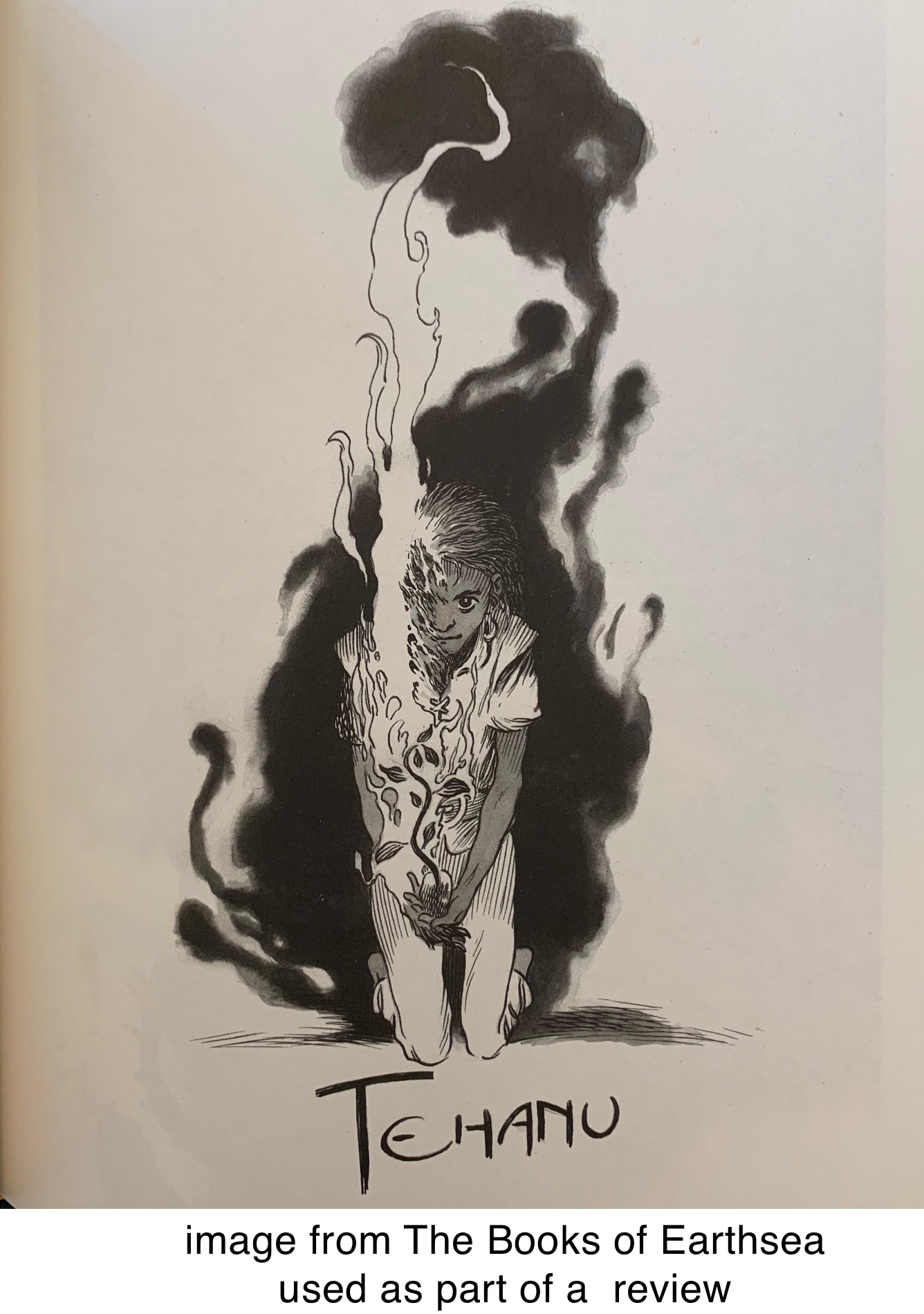
I have a British paperback that contains the first four Earthsea novels that’s tattered from both my wife and I rereading it, but we both love it so much we’ll never throw it away. This brick of a book contains not only those first four books (my favorite is either A Wizard of Earthsea or The Farthest Shore, whichever I’ve reread most recently) plus Tales from Earthsea and The Other Wind, a few other related stories, and the text of a lecture Le Guin gave in 1992. Vess’ drawings bring the entire book to life for me in a new way, which is saying something as these books live in my head. Most of the illustrations are black and white, though there’s a color plate at the beginning of each book in this volume.
It’s worth noting that I’ve cheated — I’ve flipped through the book several times without reading straight through just to look at the pictures. I find myself wanting a Vess-style dragon tattoo (or one of Ged’s silhouette on Lookfar). My favorite drawing is of Ged sailing into the harbor to face the dragon of Pendor in the first book.
The binding seems extremely solid. While it’s heavy and probably a bit too unwieldy to read while standing on a bus or subway, it’s not too heavy to read while sitting. I still remember the effort it took to read the oversized two volume hardcover, The Complete Far Side. It was so worth the effort, but this book doesn’t require the logistics or the muscles of a book that big. (Every time I come across a used copy of The Complete Far Side I imagine that someone hurt their back, or thought they might.)
PS: Just last week I saw this in my local university bookstore for a fraction of the cover price, in the bargain books section. If you’ve been waiting to pick up a copy, now may be your best chance.
The Books of Earthsea: The Complete Illustrated Edition by Ursula K. Le Guin, Illustrated by Charles Vess. Saga Press, 2018. 9781481465588. 992pp.
I have a British paperback that contains the first four Earthsea novels that’s tattered from both my wife and I rereading it, but we both love it so much we’ll never throw it away. This brick of a book contains not only those first four books (my favorite is either A Wizard of Earthsea or The Farthest Shore, whichever I’ve reread most recently) plus Tales from Earthsea and The Other Wind, a few other related stories, and the text of a lecture Le Guin gave in 1992. Vess’ drawings bring the entire book to life for me in a new way, which is saying something as these books live in my head. Most of the illustrations are black and white, though there’s a color plate at the beginning of each book in this volume.
It’s worth noting that I’ve cheated — I’ve flipped through the book several times without reading straight through just to look at the pictures. I find myself wanting a Vess-style dragon tattoo (or one of Ged’s silhouette on Lookfar). My favorite drawing is of Ged sailing into the harbor to face the dragon of Pendor in the first book.
The binding seems extremely solid. While it’s heavy and probably a bit too unwieldy to read while standing on a bus or subway, it’s not too heavy to read while sitting. I still remember the effort it took to read the oversized two volume hardcover, The Complete Far Side. It was so worth the effort, but this book doesn’t require the logistics or the muscles of a book that big. (Every time I come across a used copy of The Complete Far Side I imagine that someone hurt their back, or thought they might.)
PS: Just last week I saw this in my local university bookstore for a fraction of the cover price, in the bargain books section. If you’ve been waiting to pick up a copy, now may be your best chance.

Graphic Novel Reviews: Waves by Ingrid Chabbert and Carole Maurel + In Waves by AJ Dungo
 Waves by Ingrid Chabbert, Illustrated by Carole Maurel. Translated by Edward Gauvin. Archaia, 2019. 9781684153466. 93pp.
This is Ingrid Chabbert’s account of losing her baby boy, who died shortly after he was born. Following his death, this graphic novel shifts from beautiful colors to black and white, though color slowly works its way back into the lives of Chabbert and her partner as they learn to live with their grief, and as Chabbert finishes the book she was working on for her son. This is a beautifully succinct graphic novel.
Waves by Ingrid Chabbert, Illustrated by Carole Maurel. Translated by Edward Gauvin. Archaia, 2019. 9781684153466. 93pp.
This is Ingrid Chabbert’s account of losing her baby boy, who died shortly after he was born. Following his death, this graphic novel shifts from beautiful colors to black and white, though color slowly works its way back into the lives of Chabbert and her partner as they learn to live with their grief, and as Chabbert finishes the book she was working on for her son. This is a beautifully succinct graphic novel.
 In Waves by AJ Dungo. Nobrow, 2019. 9781910620632. 373pp with a bibliography.
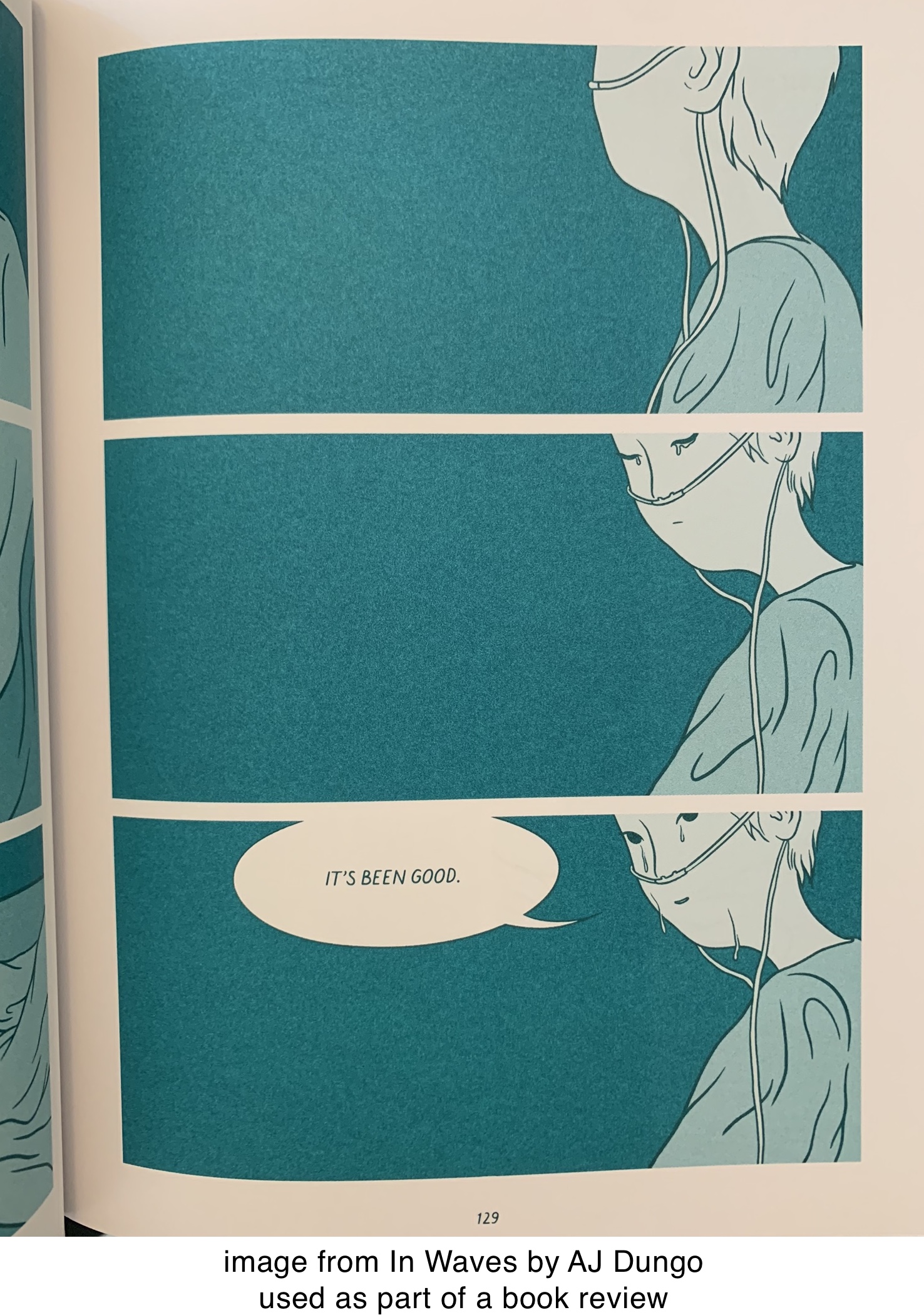
Dungo alternates the story of the love of his life (and her death from cancer) with a brief history of surfing that begins in the Hawaiian islands in 1800. Kristin liked surfing, and while Dungo doesn’t claim to be an expert about its history, his illustrations do an amazing job of showing how it makes him and Kristin feel, whether it’s her last time on the water or when he’s paddled out past the surf after her death. The story of their romance is nonlinear, their first kiss in the rain coming at the beginning of the book as he starts to write about her death eight years later. The two page spread that follows, of Dungo staring at the empty ocean, sitting on a board, is masterful — he’s alone, mourning silently. Then he’s remembering trying to get her attention, how he finally did, her diagnosis, her death, a trip up the West Coast. The story is full of joy and love and sadness, and made me feel it all while teaching me about surfing.
Worth noting: the chapters on the history of surfing could be used for a research paper by middle and high school students, and there’s nothing in this book that should keep it out of school library collections.
In Waves by AJ Dungo. Nobrow, 2019. 9781910620632. 373pp with a bibliography.
Dungo alternates the story of the love of his life (and her death from cancer) with a brief history of surfing that begins in the Hawaiian islands in 1800. Kristin liked surfing, and while Dungo doesn’t claim to be an expert about its history, his illustrations do an amazing job of showing how it makes him and Kristin feel, whether it’s her last time on the water or when he’s paddled out past the surf after her death. The story of their romance is nonlinear, their first kiss in the rain coming at the beginning of the book as he starts to write about her death eight years later. The two page spread that follows, of Dungo staring at the empty ocean, sitting on a board, is masterful — he’s alone, mourning silently. Then he’s remembering trying to get her attention, how he finally did, her diagnosis, her death, a trip up the West Coast. The story is full of joy and love and sadness, and made me feel it all while teaching me about surfing.
Worth noting: the chapters on the history of surfing could be used for a research paper by middle and high school students, and there’s nothing in this book that should keep it out of school library collections.



Graphic Novel Review: Mighty Jack and Zita the Spacegirl by Ben Hatke
 Mighty Jack and Zita the Spacegirl by Ben Hatke. First Second, 2019. 9781250191731. 254pp plus a bunch of sketches at the end.
I’m not a fan of crossover events in comics. Usually major comics companies bring together heroes or teams and no character gets enough focus to make the effort worthwhile. However Hatke’s Zita / Jack crossover is perfect as he brought together not only his two heroes, but every element you could have possibly loved in each series. He did it in a such a way that I’m going to go back and read both series again in order ASAP, followed by this book again.
The giants are bringing a war to Jack that will destroy the world. Even with Zita and her friends’ help, they need to delay the giants from breaking down the door to Earth, and to find allies for the coming battle. Basically they’re going to need everyone’s help, and things don’t go as expected. Saying any more would be a major spoiler for events in both series, so if you haven’t read them, start with the Zita the Spacegirl books now, no matter what age you are.
If you have read these, though, I will say that Tig and Jerry make an appearance, and my favorite bit may have been seeing Zita’s double again. But that’s me — I’m sure you’ll have your own favorite moment.
On a personal note, Ben is one of the nicest guys and most talented cartoonists I’ve ever met. His family recently suffered a terrible tragedy, and folks have been chipping in to help them cover the associated bills. Here’s a link to the fundraiser if you want to consider it, too. https://www.givesendgo.com/idahatke
Mighty Jack and Zita the Spacegirl by Ben Hatke. First Second, 2019. 9781250191731. 254pp plus a bunch of sketches at the end.
I’m not a fan of crossover events in comics. Usually major comics companies bring together heroes or teams and no character gets enough focus to make the effort worthwhile. However Hatke’s Zita / Jack crossover is perfect as he brought together not only his two heroes, but every element you could have possibly loved in each series. He did it in a such a way that I’m going to go back and read both series again in order ASAP, followed by this book again.
The giants are bringing a war to Jack that will destroy the world. Even with Zita and her friends’ help, they need to delay the giants from breaking down the door to Earth, and to find allies for the coming battle. Basically they’re going to need everyone’s help, and things don’t go as expected. Saying any more would be a major spoiler for events in both series, so if you haven’t read them, start with the Zita the Spacegirl books now, no matter what age you are.
If you have read these, though, I will say that Tig and Jerry make an appearance, and my favorite bit may have been seeing Zita’s double again. But that’s me — I’m sure you’ll have your own favorite moment.
On a personal note, Ben is one of the nicest guys and most talented cartoonists I’ve ever met. His family recently suffered a terrible tragedy, and folks have been chipping in to help them cover the associated bills. Here’s a link to the fundraiser if you want to consider it, too. https://www.givesendgo.com/idahatke


Graphic Novel Review: Bloodlust & Bonnets by Emily McGovern
 Bloodlust & Bonnets by Emily McGovern. Andrews McMeel, 2019. 9781449497477. 203pp.
This is the most hilariously odd graphic novel set at the end of the Regency period ever.
Miss Lucy takes a sword cane to some gentlemen that deserve it, and is invited to join a secret ancient immortal vampire cult. But then, a self-obsessed Lord Byron shows up with his psychic eagle, Napoleon, to save her. Covered in blood they fly to his castle in the Scottish Highlands. That’s just in the opening pages. In the rest: a magic castle, more vampires, an ambush, a hot vampire killer, cross dressing, Sir Walter Scott, betrayal, a ball, lust, a succubus, several amazing entrances, a lot of cartoony blood and violence, and a public bath in Bath. The whole thing is nonstop madness.
You can read more of McGovern’s comics at http://emilymcgovern.com/, including the short that this graphic novel is based on. (I love the simple cartoony style of this book way better than the style of the original short, though that looks great, too.)
Bloodlust & Bonnets by Emily McGovern. Andrews McMeel, 2019. 9781449497477. 203pp.
This is the most hilariously odd graphic novel set at the end of the Regency period ever.
Miss Lucy takes a sword cane to some gentlemen that deserve it, and is invited to join a secret ancient immortal vampire cult. But then, a self-obsessed Lord Byron shows up with his psychic eagle, Napoleon, to save her. Covered in blood they fly to his castle in the Scottish Highlands. That’s just in the opening pages. In the rest: a magic castle, more vampires, an ambush, a hot vampire killer, cross dressing, Sir Walter Scott, betrayal, a ball, lust, a succubus, several amazing entrances, a lot of cartoony blood and violence, and a public bath in Bath. The whole thing is nonstop madness.
You can read more of McGovern’s comics at http://emilymcgovern.com/, including the short that this graphic novel is based on. (I love the simple cartoony style of this book way better than the style of the original short, though that looks great, too.)


