 The Galaxy, And The Ground Within (Wayfarers Book 4) by Becky Chambers. Harper Voyager, 2021. 9780062936042. 336pp.
I’m a huge fan of Chambers’ good natured, character-centric Wayfarers series, and this, the final book, is on par with the other three. I was saving it for when I needed a boost, but after listening to Eric Molinsky interview Chambers on his Imaginary Worlds podcast, and finding out it’s the last book in the series, I read it immediately. https://www.imaginaryworldspodcast.org/episodes/becky-chambers-goes-wayfaring
The Five-Hop One-Stop is a small dome on a small, unremarkable world, Gora, at a crowded wormhole-to-wormhole transit point. Its proprietor, Ouloo, a long, furry alien, is determined to make her establishment and its array of products and services attractive and welcoming to all species. She’s also got to keep her awkward, curious child, Tupo, on course. After welcoming three shuttles and their pilots, who are in search of supplies, distraction, rest, and snacks (Ouloo specializes in the latter), Gora’s satellite system has a spectacular failure. No one can leave the planet until it’s safe. The three very different aliens are stranded together for days and forced to make the best of things. Each has xir own worries and needs, and as they get to know one another there’s a bit of conflict over differing points of view. Comedy relief is supplied, frequently, by Tupo.
Not much to go on in terms of a booktalk, I know. I could describe the different species, but nah — Chambers has done a great job sinking into their viewpointss and needs in the book, and too much detail would spoil the fun of reading it. It is worth noting that one of the characters is mentioned in another book in the series as the human captain Ashby’s romantic partner, though there are no humans in this book. The brilliant thing about Chambers’ series is you can start it anywhere.
I’m sad to see this series end, but excited to read whatever Chambers publishes next. In fact her next book, A Psalm for the Wild-Built, is already out.
The Galaxy, And The Ground Within (Wayfarers Book 4) by Becky Chambers. Harper Voyager, 2021. 9780062936042. 336pp.
I’m a huge fan of Chambers’ good natured, character-centric Wayfarers series, and this, the final book, is on par with the other three. I was saving it for when I needed a boost, but after listening to Eric Molinsky interview Chambers on his Imaginary Worlds podcast, and finding out it’s the last book in the series, I read it immediately. https://www.imaginaryworldspodcast.org/episodes/becky-chambers-goes-wayfaring
The Five-Hop One-Stop is a small dome on a small, unremarkable world, Gora, at a crowded wormhole-to-wormhole transit point. Its proprietor, Ouloo, a long, furry alien, is determined to make her establishment and its array of products and services attractive and welcoming to all species. She’s also got to keep her awkward, curious child, Tupo, on course. After welcoming three shuttles and their pilots, who are in search of supplies, distraction, rest, and snacks (Ouloo specializes in the latter), Gora’s satellite system has a spectacular failure. No one can leave the planet until it’s safe. The three very different aliens are stranded together for days and forced to make the best of things. Each has xir own worries and needs, and as they get to know one another there’s a bit of conflict over differing points of view. Comedy relief is supplied, frequently, by Tupo.
Not much to go on in terms of a booktalk, I know. I could describe the different species, but nah — Chambers has done a great job sinking into their viewpointss and needs in the book, and too much detail would spoil the fun of reading it. It is worth noting that one of the characters is mentioned in another book in the series as the human captain Ashby’s romantic partner, though there are no humans in this book. The brilliant thing about Chambers’ series is you can start it anywhere.
I’m sad to see this series end, but excited to read whatever Chambers publishes next. In fact her next book, A Psalm for the Wild-Built, is already out. 
Latest Comics
-

#1344. twelve hundred fifty four
Feb 04, 2026
-

#1343. twelve hundred fifty three
Feb 02, 2026
-

#1342. twelve hundred fifty two
Jan 28, 2026
-
#1341. twelve hundred fifty one
Jan 26, 2026
-

#1340. twelve hundred fifty
Jan 21, 2026
-

#1339. twelve hundred forty nine
Jan 19, 2026
-
#1338. twelve hundred forty eight
Jan 14, 2026
-
#1337. twelve hundred forty seven
Jan 12, 2026
-

#1336. twelve hundred forty six
Jan 07, 2026
-
#1335. twelve hundred forty five
Jan 05, 2026
Book Review: The Galaxy, And The Ground Within (Wayfarers Book 4) by Becky Chambers.
The Galaxy, And The Ground Within (Wayfarers Book 4) by Becky Chambers. Harper Voyager, 2021. 9780062936042. 336pp.
I’m a huge fan of Chambers’ good natured, character-centric Wayfarers series, and this, the final book, is on par with the other three. I was saving it for when I needed a boost, but after listening to Eric Molinsky interview Chambers on his Imaginary Worlds podcast, and finding out it’s the last book in the series, I read it immediately. https://www.imaginaryworldspodcast.org/episodes/becky-chambers-goes-wayfaring
The Five-Hop One-Stop is a small dome on a small, unremarkable world, Gora, at a crowded wormhole-to-wormhole transit point. Its proprietor, Ouloo, a long, furry alien, is determined to make her establishment and its array of products and services attractive and welcoming to all species. She’s also got to keep her awkward, curious child, Tupo, on course. After welcoming three shuttles and their pilots, who are in search of supplies, distraction, rest, and snacks (Ouloo specializes in the latter), Gora’s satellite system has a spectacular failure. No one can leave the planet until it’s safe. The three very different aliens are stranded together for days and forced to make the best of things. Each has xir own worries and needs, and as they get to know one another there’s a bit of conflict over differing points of view. Comedy relief is supplied, frequently, by Tupo.
Not much to go on in terms of a booktalk, I know. I could describe the different species, but nah — Chambers has done a great job sinking into their viewpointss and needs in the book, and too much detail would spoil the fun of reading it. It is worth noting that one of the characters is mentioned in another book in the series as the human captain Ashby’s romantic partner, though there are no humans in this book. The brilliant thing about Chambers’ series is you can start it anywhere.
I’m sad to see this series end, but excited to read whatever Chambers publishes next. In fact her next book, A Psalm for the Wild-Built, is already out. Graphic Novel Review: The Magic Fish by Trung Le Nguyen
 The Magic Fish by Trung Le Nguyen. RH Graphic, 2020. 9781984851598. 229 pages of comics plus an author’s not, an essay on creating the graphic novel, and some pages of bonus artwork.
At the center of this story are Tién (13) and his mother. Tién speaks mostly English; his mother speaks mostly Vietnamese. As Tién reads a version of Cinderella to his mother, she thinks about saying goodbye to her mother when she and her husband fled Vietnam. Later Tién’s mother travels to Vietnam after his grandmother dies, and as she questions her identity and mourns, her auntie tells her a different version of the myth. (Back in the US, Tién’s crush on his friend Julian is noticed during a school dance, and he’s sent to counseling, to talk to a priest who tells him he’s going to break his mother’s heart. And once Tién’s mother returns home, the school takes the decision to come out to his mom out of Tién’s hands. But they share another story, a beautiful retelling of The Little Mermaid, that lets Tién know she loves and accepts him.
Nguyen has a gift for depicting how hard it is for a kid and their mother to communicate when they speak different first languages and were raised in different cultures. I’ve never seen a book do this before, and it’s wonderful. Equally beautiful are the illustrations, particularly the way each tale has its own design and fashion sense. (The pages at the end give Nguyen space to explain his choices.)
This is the best graphic novel I’ve read this year, and one that I know everyone in my family will enjoy.
The Magic Fish by Trung Le Nguyen. RH Graphic, 2020. 9781984851598. 229 pages of comics plus an author’s not, an essay on creating the graphic novel, and some pages of bonus artwork.
At the center of this story are Tién (13) and his mother. Tién speaks mostly English; his mother speaks mostly Vietnamese. As Tién reads a version of Cinderella to his mother, she thinks about saying goodbye to her mother when she and her husband fled Vietnam. Later Tién’s mother travels to Vietnam after his grandmother dies, and as she questions her identity and mourns, her auntie tells her a different version of the myth. (Back in the US, Tién’s crush on his friend Julian is noticed during a school dance, and he’s sent to counseling, to talk to a priest who tells him he’s going to break his mother’s heart. And once Tién’s mother returns home, the school takes the decision to come out to his mom out of Tién’s hands. But they share another story, a beautiful retelling of The Little Mermaid, that lets Tién know she loves and accepts him.
Nguyen has a gift for depicting how hard it is for a kid and their mother to communicate when they speak different first languages and were raised in different cultures. I’ve never seen a book do this before, and it’s wonderful. Equally beautiful are the illustrations, particularly the way each tale has its own design and fashion sense. (The pages at the end give Nguyen space to explain his choices.)
This is the best graphic novel I’ve read this year, and one that I know everyone in my family will enjoy.


Picture Book Reviews!
 Wildflowers: A Toon Book by Liniers. (Toon Level Two). Toon Books, 2021. 9781943145539.
Inspired by his three daughters looking at the Mexican jungle (there’s a charming photo of them doing this in the back of the book), this early reader graphic novel is about three girls trapped on a mysterious island after a plane crash. As they start to explore the jungle, they come across exotic wildflowers, a tiny animal, and another that’s big and growly. If you’ve never read any of Liniers’ comics before, do yourself a favor and pick this one up: it’s silly, a little scary, and has a lot of heart.
The Airport Book by Lisa Brown. Roaring Brook Press, 2016. 9781626720916.
Wildflowers: A Toon Book by Liniers. (Toon Level Two). Toon Books, 2021. 9781943145539.
Inspired by his three daughters looking at the Mexican jungle (there’s a charming photo of them doing this in the back of the book), this early reader graphic novel is about three girls trapped on a mysterious island after a plane crash. As they start to explore the jungle, they come across exotic wildflowers, a tiny animal, and another that’s big and growly. If you’ve never read any of Liniers’ comics before, do yourself a favor and pick this one up: it’s silly, a little scary, and has a lot of heart.
The Airport Book by Lisa Brown. Roaring Brook Press, 2016. 9781626720916.  Brown’s book starts with a family packing and then leaving for a trip. Her elegant drawings make everything look at least a little fun, from traffic to standing in lines to airport security. Every two-page spread is full of amazing people leaving on journeys and doing their jobs, and the word balloons make it all work. I’m going to read this before my trip this weekend — I’m a nervous flier (when I’m not terrified), and I think this will help.
Cton’s Super A-Maze-Ing Year Of Crazy Comics! Puzzles, Mazes, Blobs, & More by Clayton Hanmer. Owlkids, 2008. 9782895792093.
I’ve had this book for years, and I love looking at it. It’s happy and weird and pretty funny, and has pages where I can get lost in the details, like “Billy’s Spooky Halloween Adventure (which is at the beginning). Learn to draw Blob, and his hillbilly cousin Blab! Then move on to winter: Blob skis, Cton shows off his snowboard, and weird winter myths are explained. There are comics mazes and more illustrations of Cton’s friends, and Cton even shows how to plant a tree. Throughout it encourages and inspires creativity, and ends with tips on making comics. (And there are answers to the puzzles in the book.)
Worth noting: All of the activities in the book can be completed without drawing in the book itself. Use a finger on the mazes!
Brown’s book starts with a family packing and then leaving for a trip. Her elegant drawings make everything look at least a little fun, from traffic to standing in lines to airport security. Every two-page spread is full of amazing people leaving on journeys and doing their jobs, and the word balloons make it all work. I’m going to read this before my trip this weekend — I’m a nervous flier (when I’m not terrified), and I think this will help.
Cton’s Super A-Maze-Ing Year Of Crazy Comics! Puzzles, Mazes, Blobs, & More by Clayton Hanmer. Owlkids, 2008. 9782895792093.
I’ve had this book for years, and I love looking at it. It’s happy and weird and pretty funny, and has pages where I can get lost in the details, like “Billy’s Spooky Halloween Adventure (which is at the beginning). Learn to draw Blob, and his hillbilly cousin Blab! Then move on to winter: Blob skis, Cton shows off his snowboard, and weird winter myths are explained. There are comics mazes and more illustrations of Cton’s friends, and Cton even shows how to plant a tree. Throughout it encourages and inspires creativity, and ends with tips on making comics. (And there are answers to the puzzles in the book.)
Worth noting: All of the activities in the book can be completed without drawing in the book itself. Use a finger on the mazes!


Graphic Novel Review: Farm Crimes! Cracking The Case Of The Missing Egg by Sandra Dumais
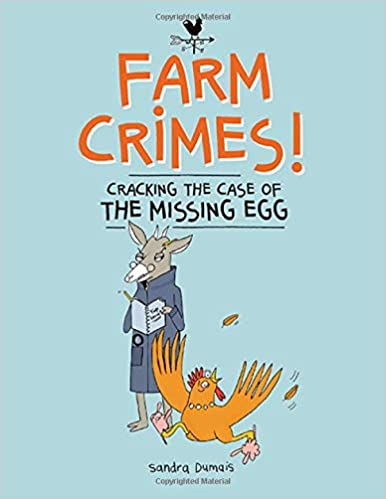 Farm Crimes! Cracking The Case Of The Missing Egg by Sandra Dumais. Owlkids, 2020. 9781771474153. 48pp.
This is a very short mystery great for kids who are just graduating from picture books. A hen suddenly freaks out because her egg is missing. The animals are worried about a burglar, so they ring the cow’s bell three times, calling Inspector Billiam Van Hoof, the world’s #1 goat detective, from his house on the other side of the farm. He grabs his tools (including his detective sandals) and takes a very roundabout way to the scene of the crime. Then he’s on the job, which he takes a bit too seriously. It’s not long before the the mystery is solved. (It’s almost certain kids will solve it first, which is a lot of the fun.)
Loved the illustrations, particularly the chicken (she’s very worked up), the raccoon (still not sure why he’s wearing shorts) and of course the detective (his disguise is a bit ridiculous). Like so many graphic novels originally published in France, the colors are wonderful.
Farm Crimes! Cracking The Case Of The Missing Egg by Sandra Dumais. Owlkids, 2020. 9781771474153. 48pp.
This is a very short mystery great for kids who are just graduating from picture books. A hen suddenly freaks out because her egg is missing. The animals are worried about a burglar, so they ring the cow’s bell three times, calling Inspector Billiam Van Hoof, the world’s #1 goat detective, from his house on the other side of the farm. He grabs his tools (including his detective sandals) and takes a very roundabout way to the scene of the crime. Then he’s on the job, which he takes a bit too seriously. It’s not long before the the mystery is solved. (It’s almost certain kids will solve it first, which is a lot of the fun.)
Loved the illustrations, particularly the chicken (she’s very worked up), the raccoon (still not sure why he’s wearing shorts) and of course the detective (his disguise is a bit ridiculous). Like so many graphic novels originally published in France, the colors are wonderful.

Book Review: TO:KY:OO by Liam Wong.
 TO:KY:00 by Liam Wong. Thames & Hudson, 2021. 9780500545461. 264pp.
Photography books need to be beautiful and compelling, and this one is on a new level. The opening pages, including the forward and introduction and table of contents, are all printed on beautiful gradients that flow across both pages. The behind-the-scenes pages at the back that show a few of Wong’s contact sheets and give real insight into his process (particularly of the process behind making his famous Neo Tokyo photograph) are on a non-glossy paper, which sets them apart from the glossiness of the rest of the book and makes them feel like they’re full of craft. Everyone is going to want to flip through this book.
The photos themselves are wonderful. The recolored night scenes are full of purples, with glowing blues and whites and reds. In so many images signs, lit and not, neon and not, vie for attention even as pedestrians ignore them. There’s something unexpected in each image, which made paging through this book again and again a real pleasure. Many rainy Tokyo streets and alleys recall the movie Blade Runner, though there’s so much more here that doesn’t. It all makes me want to get on a plane and head for Japan as soon as that’s possible again.
TO:KY:00 by Liam Wong. Thames & Hudson, 2021. 9780500545461. 264pp.
Photography books need to be beautiful and compelling, and this one is on a new level. The opening pages, including the forward and introduction and table of contents, are all printed on beautiful gradients that flow across both pages. The behind-the-scenes pages at the back that show a few of Wong’s contact sheets and give real insight into his process (particularly of the process behind making his famous Neo Tokyo photograph) are on a non-glossy paper, which sets them apart from the glossiness of the rest of the book and makes them feel like they’re full of craft. Everyone is going to want to flip through this book.
The photos themselves are wonderful. The recolored night scenes are full of purples, with glowing blues and whites and reds. In so many images signs, lit and not, neon and not, vie for attention even as pedestrians ignore them. There’s something unexpected in each image, which made paging through this book again and again a real pleasure. Many rainy Tokyo streets and alleys recall the movie Blade Runner, though there’s so much more here that doesn’t. It all makes me want to get on a plane and head for Japan as soon as that’s possible again.


Graphic Novel Review: Superman’s Pal Jimmy Olsen: Who Killed Jimmy Olsen? by Matt Fraction and Steve Leiber
 Superman’s Pal Jimmy Olsen: Who Killed Jimmy Olsen? by Matt Fraction (writer) and Steve Leiber (artist). DC Comics, 2020. 9781779504623. Includes Superman’s Pal Jimmy Olsen 1 – 12 and material from Superman: Leviathan Rising Special 1.
This graphic novel opens with Daily Planet photographer Jimmy Olsen on a book tour, waking up naked and married in Gorilla City after an evening of drinking. His wife, Jinx, and interdimensional jewel thief, makes him promise to get their marriage annulled. Then a cat attacks him in the bathroom, then barfs blood all over Jimmy and the room. Both the cat and the jewel thief play into the plot of the book, which involves Olsen getting “killed,” going into hiding, a series of ridiculous impersonations, and the history of Metropolis (involving the Olsens and the Luthors). It’s a beautiful piece of non-stop ridiculousness involving the hero Metallo, the greatest Batman gags ever, and, of course, a little Superman (but not as much as you’d expect in a book about Olsen if you’re a comic reader about my age). There are a ton of pages that are formatted like the first pages of a comic book, featuring a lot of explain-y text and narration and a logo — a brilliant bit of silliness that keeps the whole book rolling along at high speed even as they seem to restart the story. Leiber is one of the best artists working in comics; his mastery of tone, storytelling, and character are evident on every page.
This is favorite “superhero” comic of the year, and the funniest book I’ve read in a while.
Superman’s Pal Jimmy Olsen: Who Killed Jimmy Olsen? by Matt Fraction (writer) and Steve Leiber (artist). DC Comics, 2020. 9781779504623. Includes Superman’s Pal Jimmy Olsen 1 – 12 and material from Superman: Leviathan Rising Special 1.
This graphic novel opens with Daily Planet photographer Jimmy Olsen on a book tour, waking up naked and married in Gorilla City after an evening of drinking. His wife, Jinx, and interdimensional jewel thief, makes him promise to get their marriage annulled. Then a cat attacks him in the bathroom, then barfs blood all over Jimmy and the room. Both the cat and the jewel thief play into the plot of the book, which involves Olsen getting “killed,” going into hiding, a series of ridiculous impersonations, and the history of Metropolis (involving the Olsens and the Luthors). It’s a beautiful piece of non-stop ridiculousness involving the hero Metallo, the greatest Batman gags ever, and, of course, a little Superman (but not as much as you’d expect in a book about Olsen if you’re a comic reader about my age). There are a ton of pages that are formatted like the first pages of a comic book, featuring a lot of explain-y text and narration and a logo — a brilliant bit of silliness that keeps the whole book rolling along at high speed even as they seem to restart the story. Leiber is one of the best artists working in comics; his mastery of tone, storytelling, and character are evident on every page.
This is favorite “superhero” comic of the year, and the funniest book I’ve read in a while.


Gene and Willow Interviewed on the Circulating Ideas Podcast
 https://circulatingideas.com/2021/06/29/202-library-comic-gene-ambaum-and-willow-payne/
Listen to Willow and I talk with Steve Thomas on the latest episode of Circulating Ideas! We cover Unshelved a bit — the last time I was on the podcast was 10 years ago, on Episode #2 with Bill Barnes — and also chat about why there have been so many spiders in Library Comic in the last few years plus working together. Hearing Willow complain about my bad taste in books was the highlight for me.
https://circulatingideas.com/2021/06/29/202-library-comic-gene-ambaum-and-willow-payne/
Listen to Willow and I talk with Steve Thomas on the latest episode of Circulating Ideas! We cover Unshelved a bit — the last time I was on the podcast was 10 years ago, on Episode #2 with Bill Barnes — and also chat about why there have been so many spiders in Library Comic in the last few years plus working together. Hearing Willow complain about my bad taste in books was the highlight for me.
Book Review: I Can Draw by Peng
 I Can Draw by Peng. Thames & Hudson, 2021. 9780500652428. 160pp.
Peng’s book is full of smudges and weird brush strokes and scribbles and I can’t quite explain this but it feels like it’s full of smudges and fingerprints, too. Like it’s as weird and chaotic as my failed drawings, and also like it’s showing me the way forward from that. (I normally hate books on drawing — they seem to be full of nonsensical lessons that say, “Combine these two basic poorly drawn shapes and voila(!) you can draw a fully realized anatomically correct person!” BS.) Peng encourages budding artists to start with a few basic materials and just to start moving them on the page. The first two chapters, almost half the book, focus on drawing people. Later chapters are on birds and dogs and cats and other animals and then comics. It’s a very indirect cartooning course which, at just the right moments, encourages scribbling. I love it for everything it has and everything it doesn’t.
The book itself is oversized and spacious, and the words are few. It will sit on my shelf next to Linda Barry’s What It Is and Picture This, but like those books it will spend a lot of time on my desk, too.
I Can Draw by Peng. Thames & Hudson, 2021. 9780500652428. 160pp.
Peng’s book is full of smudges and weird brush strokes and scribbles and I can’t quite explain this but it feels like it’s full of smudges and fingerprints, too. Like it’s as weird and chaotic as my failed drawings, and also like it’s showing me the way forward from that. (I normally hate books on drawing — they seem to be full of nonsensical lessons that say, “Combine these two basic poorly drawn shapes and voila(!) you can draw a fully realized anatomically correct person!” BS.) Peng encourages budding artists to start with a few basic materials and just to start moving them on the page. The first two chapters, almost half the book, focus on drawing people. Later chapters are on birds and dogs and cats and other animals and then comics. It’s a very indirect cartooning course which, at just the right moments, encourages scribbling. I love it for everything it has and everything it doesn’t.
The book itself is oversized and spacious, and the words are few. It will sit on my shelf next to Linda Barry’s What It Is and Picture This, but like those books it will spend a lot of time on my desk, too.


Picture Book Reviews!
 Life on Surtsey Iceland’s Upstart Island (Scientists in the Field) by Loree Griffin Burns. Houghton Mifflin Harcourt, 2017. 9780544687233. 73pp. including an index, source notes, photo credits, a selected bibliography, and a list of resources to turn to for more information.
My friend and one-time book review collaborator Sarah Hunt, who used to work with me on Book Threat, loves the Scientists in the Field series, and I’ve had this on my shelf for years. Its focus is on the island of Surtsey, a new island that appeared off the coast of Iceland in 1963. And it also focuses on biologist Erling Ólafsson, who saw the forming island’s ash plume as a young teen, and who has been helping carry out studies of how life has taken root on the island since 1970. An entomologist, we get to see how he uses pitfall traps to capture terrestrial insects, and we also get a sense of how keen his eye is — apparently he can see bugs the rest of us can’t (and grabs them in the name of science). My favorite part of the book: the explanation of how scientists on Surtsey use the “bathroom,” particularly when they need to go #2. Ólafsson’s story will inspire would-be young scientists, and his photographs will make them dream of visiting the island, too.
Life on Surtsey Iceland’s Upstart Island (Scientists in the Field) by Loree Griffin Burns. Houghton Mifflin Harcourt, 2017. 9780544687233. 73pp. including an index, source notes, photo credits, a selected bibliography, and a list of resources to turn to for more information.
My friend and one-time book review collaborator Sarah Hunt, who used to work with me on Book Threat, loves the Scientists in the Field series, and I’ve had this on my shelf for years. Its focus is on the island of Surtsey, a new island that appeared off the coast of Iceland in 1963. And it also focuses on biologist Erling Ólafsson, who saw the forming island’s ash plume as a young teen, and who has been helping carry out studies of how life has taken root on the island since 1970. An entomologist, we get to see how he uses pitfall traps to capture terrestrial insects, and we also get a sense of how keen his eye is — apparently he can see bugs the rest of us can’t (and grabs them in the name of science). My favorite part of the book: the explanation of how scientists on Surtsey use the “bathroom,” particularly when they need to go #2. Ólafsson’s story will inspire would-be young scientists, and his photographs will make them dream of visiting the island, too.
 Bloom by Doreen Cronin and David Small. Atheneum Books for Young Readers, 2016. 9781442406209.
I don’t often enjoy fairies or books that I’d describe as delightful, but this one is great. Bloom is a filthy fairy who helps create a large, shiny, delicate kingdom whose residents eventually do nothing but complain about her. She leaves for the heart of the forest, but then the kingdom falls apart. When they send folks out to find her and her magic, she offers them mud (which, spoiler, is what they need), and they’re mostly disgusted. (Someone finally gets it though.) Small’s illustrations are perfectly haughty and dirty and playful, and I love the brown fonts and they way big words on the page help the story along.
Bloom by Doreen Cronin and David Small. Atheneum Books for Young Readers, 2016. 9781442406209.
I don’t often enjoy fairies or books that I’d describe as delightful, but this one is great. Bloom is a filthy fairy who helps create a large, shiny, delicate kingdom whose residents eventually do nothing but complain about her. She leaves for the heart of the forest, but then the kingdom falls apart. When they send folks out to find her and her magic, she offers them mud (which, spoiler, is what they need), and they’re mostly disgusted. (Someone finally gets it though.) Small’s illustrations are perfectly haughty and dirty and playful, and I love the brown fonts and they way big words on the page help the story along.
 The Wolf The Duck & The Mouse by Mac Barnett, illustrated by Jon Klassen. Candlewick, 2017. 9780763677541.
This is one of those picture books with a ton of shelf appeal because the characters on the cover seem to be meeting your eyes. It’s about a mouse that’s swallowed by a wolf. In the wolf’s belly he meets a duck who lives there (though he has no intention of being eaten). They do a joyous dance when the mouse asks the duck if he can stay, too. When a hunter goes after the wolf, they help defend their home. It’s very odd.
The Wolf The Duck & The Mouse by Mac Barnett, illustrated by Jon Klassen. Candlewick, 2017. 9780763677541.
This is one of those picture books with a ton of shelf appeal because the characters on the cover seem to be meeting your eyes. It’s about a mouse that’s swallowed by a wolf. In the wolf’s belly he meets a duck who lives there (though he has no intention of being eaten). They do a joyous dance when the mouse asks the duck if he can stay, too. When a hunter goes after the wolf, they help defend their home. It’s very odd.


Graphic Novel Review: Chef Yasmina and the Potato Panic by Wauter Mannaert
 Chef Yasmina and the Potato Panic by Wauter Mannaert. First Second, 2019. 9781250622044. 160pp. including a bit at the end on the origin of french fries and this graphic novel plus some pages showing Mannaert’s character design progress and thumbnails.
Yasmina loves cooking for her father, Omran, in their tiny apartment. They’re poor so she gets great ingredients from foraging, from her friends Cyril and Marco (who both have fabulous vegetable patches but different philosophies on growing them), and from her neighbor’s rooftop garden, which she sometimes sneaks into.
One day a villain, Tom de Perre, plows under Cyril and Marco’s gardens on behalf of a large company with a spooky logo. They’re going to grow potatoes the 21st Century way, and they’re going to be irresistible. (This has something to do with the weird experiment at the front of the book, which produces a flying potato, and with the garden atop the building where Yasmina lives.)
Soon everyone is eating the company’s potatoes, as chips and as fries at the restaurant where Yasmina’s dad works. And they are irresistible — in fact they drive everyone who eat them crazy, and all they want is to eat more more more!
The whole thing is charming and cartoony, and the pages are all drawn without panel borders, so it looks as organic as Marco’s veggies. This is a very entertaining, completely over-the-top story about genetically modified food that might serve as a good conversation starter.
Chef Yasmina and the Potato Panic by Wauter Mannaert. First Second, 2019. 9781250622044. 160pp. including a bit at the end on the origin of french fries and this graphic novel plus some pages showing Mannaert’s character design progress and thumbnails.
Yasmina loves cooking for her father, Omran, in their tiny apartment. They’re poor so she gets great ingredients from foraging, from her friends Cyril and Marco (who both have fabulous vegetable patches but different philosophies on growing them), and from her neighbor’s rooftop garden, which she sometimes sneaks into.
One day a villain, Tom de Perre, plows under Cyril and Marco’s gardens on behalf of a large company with a spooky logo. They’re going to grow potatoes the 21st Century way, and they’re going to be irresistible. (This has something to do with the weird experiment at the front of the book, which produces a flying potato, and with the garden atop the building where Yasmina lives.)
Soon everyone is eating the company’s potatoes, as chips and as fries at the restaurant where Yasmina’s dad works. And they are irresistible — in fact they drive everyone who eat them crazy, and all they want is to eat more more more!
The whole thing is charming and cartoony, and the pages are all drawn without panel borders, so it looks as organic as Marco’s veggies. This is a very entertaining, completely over-the-top story about genetically modified food that might serve as a good conversation starter.

