Overview | Getting Ready | Rules Overview | Detailed Rules | FAQ | Rules Variations | printable PDF summary of Turns / playing PP cards
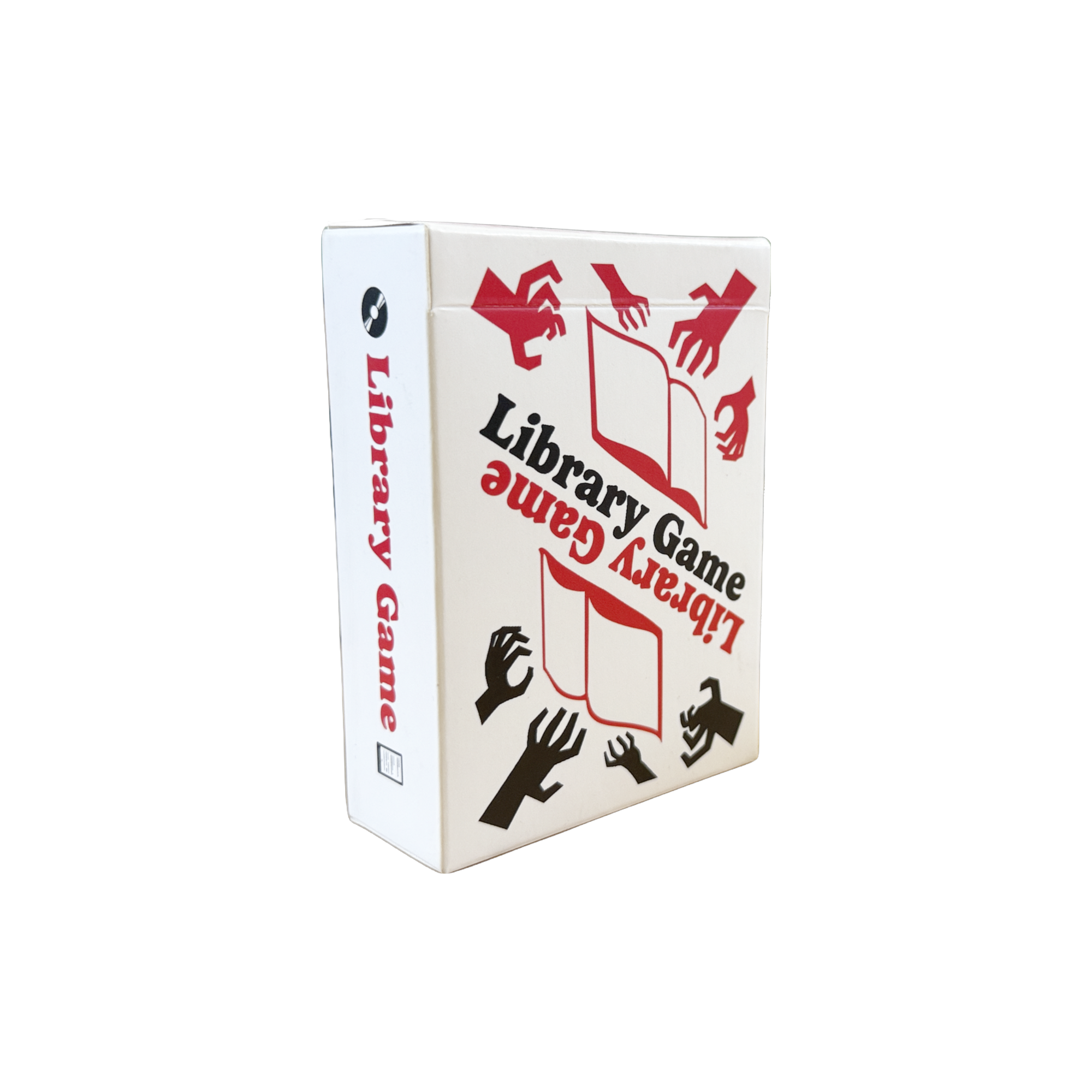 Library Game is a rummy-like, library-themed card game played over multiple rounds.
Players conduct research in the library stacks to gather sets and series of information resources. The folks who work in the library would love a chance to help! But there are also problem patrons who enjoy breaking the rules, and staff may have to deal with them instead.
Can you be the first player each round to play all your cards and check out? Cards in your hand at the end of a round count against you. At the end of the game, the player with the lowest score wins.
Recommended for 3–7 players, though it’s possible to play with a few more!
The Cards

The deck includes the following cards:
- 65 cards in 5 suits, Ace through King. The suits represent library resources:
- reference
- books
- ebooks
- periodicals
- media
- 9 Library Staff (L) cards. These feature helpful library employees from Library Comic. They’re wild (cards)!
- 10 Problem Patron (PP) cards. They can make things tough for everyone.
- A card with a QR code linking to this webpage.
Getting Ready
-
- Get a pencil and paper to keep score unless you have a really good memory.
- A regular game includes the 65 suited cards plus 4 Problem Patron (PP) cards and 4 Library Staff (L) cards. Select 4 Problem Patron (PP) cards and 4 Library Staff (L) cards and add them to the 65 suited cards. (There are more L and PP cards than that in the deck, so just use your favorites. You can opt to add more or fewer of each, too.)
- Shuffle the deck. (Do this before each later round, too.)
- Agree on the number of rounds to play. (We recommend at least 3.)
- Select the first dealer. We recommend choosing the person who gives the most compelling 30-second booktalk about a book they read recently. Later rounds should be dealt by the person who checked out and ended the previous round.
- Starting to the dealer’s left and proceeding clockwise, deal each player 7 cards. (If you have more than 7 players, or just want to try something different, you may deal a few more or fewer cards.)
- Divide the remaining cards into 2 roughly equal piles, and place those in the center of the table face down. These are the stacks.
- Turn over the top card of either of the stacks and place it next to them to start the discard pile. (There’s only one discard pile.)
- The person to the left of the dealer plays first.
Rules Overview
Turn Overview
There’s a more detailed explanation of all of this below, plus a printable one-page cheat sheet about taking a turn, too, but here’s an outline of a player’s turn:
- Take either of the top face-down cards from the stacks or the most recently “returned” card (the face-up card on top of the discard pile).
- Do one and only one of the following actions:
- Play a set or series from your hand in front of you.
Sets are 3 – 5 cards with the same number or letter. L cards are wild and may be played in place of any card not present in a set.
Series consist of 3 or more sequential cards of the same suit. Aces are low. The longest possible series is Ace through King. L cards can also be played in place of any card in a series.
- Add card(s) to an existing set or series in front of any player. Card(s) can be added to one and only one set or series per turn. Cards added can include L cards.
- Play a Problem Patron (PP) card. (The most complicated element of the game! See detailed rules on this here.)
Players “almost” always end their turn by discarding a card face up to the top of the discard pile. (See the ** note in the Only YOU Can Stop Problem Patrons section below.)
Then it’s the next player’s turn.
Checking Out
The winner of each round is the player who checks out by having no cards in their hand when it would be their turn. (They have played all of their cards into sets and series, discarded their last card, and not been forced to pick up cards by another player.)
Everyone still holding cards adds up the point values of the cards in their hands:
- A – 9 are 5 points each
- 10 – K are 10 points each
- L cards are 20 points each
- PP cards are 50 points each
Record each player’s point total for the round. The player who checked out shuffles and deals the next hand.
End of the Game
At the end of the last round, the player with the lowest total score wins.
Detailed Rules
Turn Overview (Detailed)
On a player’s turn, after picking up a card from either of the stacks or the face-up draw pile, they may do one and only one of the following:
1) Play any valid set or series of 3 or more cards from their hand.
Sets consist of 3 – 5 cards with the same number or letter. The maximum number of cards in a set is 5 because that’s what’s in the deck.
Series are made up of 3 or more sequential cards in the same suit. Aces are low, so the longest possible series is A – K (13 cards).
L cards are wild, but can only be used in place of cards that would be present in a set or series. They cannot be used to add a sixth card to a set, or to add an imaginary card to a series below an Ace, above a King, or in a spot like between a 7 and an 8. When played, it should be clear what card an L card is standing in for. (If an L card is the third card in a set, it is standing in for any of the 3 suited cards of the same number or letter that aren’t present in the set already. If an L card is the fourth card in a set, it is seen to be standing in for either of the 2 cards that are not there.)
L cards can stand in for cards that have been played in other face-up sets and series.
3 or more PP cards can be played as a set. L cards can be added to such sets as wild cards. The maximum number of cards in this set is 9.
3 or more L cards can also be played as a set. Up to 9 cards can be played in this set.
2) Add card(s) to an existing set or series in front of any player.
Card(s) can be added to one and only one set or series in front of the player themself or another player. One or more cards, including L cards, may be played from a player’s hand in this way.
In the course of adding card(s) to a set or series, cards may replace one or more L cards. When L cards are replaced in this way, they must be taken into the hand of the player who added card(s) to the set or series.
3) Play a Problem Patron (PP) card.
Problem Patron cards allow players to break the rules.
After playing one, first see if anyone wants to play an L card to trespass the PP from the library (see Only YOU Can Stop Problem Patrons!).
If no L card is played, the player who played the PP card can take a card from anywhere: anyplace in the discard pile, the top of either stack, or any set or series already played in front of another player.
- If a card is taken from the discard pile, the order of the other cards should not be altered.
The selected card is added to the player’s hand, and play continues with the player discarding a card to end their turn.
The Problem Patron card should then be shuffled back into one of the stacks.
- If a card is taken from a set or series in front of another player:
Check if that set or series is still valid. (Valid sets have 3 or more cards, and valid series have 3 or more cards of the same suit that are sequential.) If a set or series now has fewer than 3 cards, the player they’re in front of must pick up the cards that don’t form a valid set or series and return them to their hand. If a series has been broken up in the middle, any portion of that series that is at least 3 sequential cards must be taken into the player’s hand.
If other players have added cards to the set or series, it’s possible the player will be adding cards to their hand that they didn’t play originally. This is intentional.
The player who had their card stolen, whether or not they had to return cards to their hand, may then do one of the following:
- Take the top card from either of the stacks and add it to their hand.
- Take the top card from the discard pile and add it to their hand.
- Choose to do neither.
Only YOU can stop Problem Patrons!
Problem patrons can, of course, be dealt with by library staff. But if they take the time to do this, they’re not going to be available to help anyone else for the rest of the round.
When a PP card is played, any player except the one who played the PP card may play an L card to explain the Code of Conduct to the misbehaving patron and then escort them out of the library. This is stressful and takes a lot of time and effort, plus this valiant member of the library staff will have to fill out an incident report, so the L card can’t help anyone else for a bit; L cards used in this way are removed from play until the next round. The PP is trespassed until then, too.
If this happens, put both cards to the side. They should be shuffled into the deck before the next round starts.
If more than one player wants to play an L in this way, the player whose turn will be soonest has priority.
Note**: When a Problem Patron is sent out of the game in this way, the PP card counts as the player’s discard and their turn is over.
The person who played the L card may then do one of the following:
- Take the top card from either of the stacks and add it to their hand.
- Take the top card from the discard pile and add it to their hand.
- Choose to do neither.
Play continues with the player to the left of the player who played the PP card, as normal.
Checking Out (Detailed)
A round is over when it would be a player’s turn and they have no cards in their hand. At that point they have successfully checked out and won the round! (Other players may also have no cards in their hands by this point, too.
For clarification: when a player discards their last card after playing all of the cards from their hand in either sets and series in front of them and/or other players, everyone else usually* gets one more chance to play cards.
Everyone with cards left in hand at the end of a round should add the value of the cards still in their hands and record the total. Cards have these values:
- A – 9 are 5 points each
- 10 – K are 10 points each
- L cards are 20 points each
- PP cards are 50 points each
The player who checked out shuffles the cards and deals the next round.
End of the Game (Detailed)
After playing the agreed upon number of rounds, the player with the lowest point total wins.
If there’s a tie, the player with the most L cards in the sets and series played in front of them at the end of the final round wins.
If there’s still a tie, the player who most recently filed an incident report form at work wins.
FAQ
Why do you call them “patrons”?
Some library folks call the people we help in the library “customers,” others call them “guests,” and many of us refer to the most troublesome of them in far less polite ways, in private. “Patrons” is what Gene called them in the library system where he worked, and he likes the alliteration of “problem patrons” (a term he learned in library school).
Is “problem patrons” an insult?
Not really. At Library Comic, we recognize that we’re all problem patrons at some point.
Is it a good idea to add cards to other players’ sets and series?
Sometimes? Doing so can have a few effects besides getting cards out of a player’s hand. It can make those sets or series a little more robust, and therefore more likely to remain valid after a problem patron steals a card from them. But it also means there are more cards in front of the person who initially played the set or series; if they have to take all or part of a set or series back into their hand because of a problem patron, they may have more cards than they otherwise would. This little bit of mischief is intentional.
*Is it possible to win a round even if I didn’t play my last card into a set or series on my last turn?
There’s a weird circumstance where a player can win by checking out – having no cards left in their hand when it’s their next turn – without laying down their last card(s) in a set or series at the end of their final turn. (In this case players don’t get an additional turn to try to get rid of cards from their hand.)
Here’s how it can work: if a player ends up with just an L card in their hand, and they play that to remove a PP card from the rest of the round, when it’s their turn, they will have zero cards in their hand. If this happens they’ve successfully checked out.
Our game ended in a death spiral with problem patrons being played and added back to a stack and then immediately drawn and played again, over and over, and no one could win. What the heck?
Welcome to a scenario we call “Your Worst Day at the Library.” There is a way out, though. Maybe several. Keep playing!
When should we shuffle the stacks during a round?
Recommended: when there are no face-down cards remaining in one stack and it’s time for someone to draw a card.
Really: whenever a majority of people at the table are so frustrated they agree it’s time to shuffle.
Rules Variations
The basic rule set presented above is our favorite version of the game. It can be a little brutal! So there are other ways to play, too:
Add or remove a few L and/or PP cards:
There are extras of each in the box. You may add or remove a few at random, at the dealer’s whim, by agreement, or whatever. It can be fun when the player who won the previous round does this without telling anyone else how many L and PP cards there are in the deck.
For a quicker, kinder game:
If a PP card is used to steal a card from a set or series others have played, the person who has those cards in front of them does not have to add any cards to their hand again even if they are no longer valid sets and series.
If you’ve had a bad day at work:
Take all of the PP cards out of the deck.
Ever had your “favorite” patron stand up and yell at another troublemaker, and then escorted them both out of the library together?
Problems do sometimes take care of each other! It’s an amazing moment. You can opt to allow this in the game, too. In this variant, players can play a PP or an L card (not just an L card) when a PP is played, in order to remove the played PP from the game.
If you figure out a variation that’s fun for your group, let us know and we’ll add it here!
Gene Ambaum wrote these rules. He’s had friends and professionals help edit them, but the mistakes are all his.
Questions, comments, or other helpful, positive emails can be sent to him at geneambaum@gmail.com