

A comic strip about a library.
A comic strip about a library.

#1064. one thousand nine
Jul 05, 2023

#1063. one thousand eight
Jul 03, 2023

#1062. one thousand seven
Jun 28, 2023

#1061. ala 23 4
Jun 26, 2023
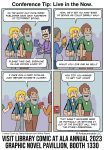
#1060. ALA 23 3
Jun 25, 2023

#1059. ALA 23 2
Jun 24, 2023

#1058. ALA 2023 1
Jun 23, 2023

#1057. one thousand six
Jun 21, 2023

#1056. one thousand five
Jun 19, 2023

#1055. one thousand four
Jun 14, 2023
 The Nightmare Brigade Vol. 1: The Girl From Déjà Vu by Franck Thilliez (story), Yomgui Dumont (art), and Drac (color). Translation by Joe Johnson. Papecutz, 2022. 9781545808771. 112pp. Originally published in French as two separate volumes.
By day Estaban and Tristan attend Jules Ferry High School. By night they help Tristan’s father’s young patients by entering their dreams as members of The Nightmare Brigade. They use a machine the professor invented, along with an airlock that leads into the dreamer’s mind. (Once in a dream that door is Estaban and Tristan’s only way back to reality. If the dreamer wakes up while they’re in their nightmare, Estaban and Tristan will be trapped there.)
Within the graphic novel are two cases, or maybe three. The first is Sarah who, like Estaban, was found in the forest suffering from amnesia a few years before the story starts. If Tristan and Estaban can figure out what’s causing her recurring nightmares they may be able to stop them. It all involves armed adults scouring a walled city looking for kids along with some weirder stuff. (On the plus side, people from reality each get a special power while inside nightmares. On the negative side, if anything from the nightmares ever finds its way out of the airlock, our world will be in real trouble.) The second case involves a kid having nightmares about a nuclear accident and a terrifying fairy. There’s also another young man, a prisoner in the professor’s lab, into whose mind Tristan’s mother disappeared.
It’s a bit strange, and sure to appeal to young teens who fondly remember things like Goosebumps. By the end of this volume, the Nightmare Brigade has a new member and Tristan has discovered his secret origin, which sets up the next book in the series.
The Nightmare Brigade Vol. 1: The Girl From Déjà Vu by Franck Thilliez (story), Yomgui Dumont (art), and Drac (color). Translation by Joe Johnson. Papecutz, 2022. 9781545808771. 112pp. Originally published in French as two separate volumes.
By day Estaban and Tristan attend Jules Ferry High School. By night they help Tristan’s father’s young patients by entering their dreams as members of The Nightmare Brigade. They use a machine the professor invented, along with an airlock that leads into the dreamer’s mind. (Once in a dream that door is Estaban and Tristan’s only way back to reality. If the dreamer wakes up while they’re in their nightmare, Estaban and Tristan will be trapped there.)
Within the graphic novel are two cases, or maybe three. The first is Sarah who, like Estaban, was found in the forest suffering from amnesia a few years before the story starts. If Tristan and Estaban can figure out what’s causing her recurring nightmares they may be able to stop them. It all involves armed adults scouring a walled city looking for kids along with some weirder stuff. (On the plus side, people from reality each get a special power while inside nightmares. On the negative side, if anything from the nightmares ever finds its way out of the airlock, our world will be in real trouble.) The second case involves a kid having nightmares about a nuclear accident and a terrifying fairy. There’s also another young man, a prisoner in the professor’s lab, into whose mind Tristan’s mother disappeared.
It’s a bit strange, and sure to appeal to young teens who fondly remember things like Goosebumps. By the end of this volume, the Nightmare Brigade has a new member and Tristan has discovered his secret origin, which sets up the next book in the series.


 Asadora! Volume 1 by Naoki Urasawa / N Wood Studio. Translation & adaptation by John Werry. Viz, 2021. 9781974717460. Publisher’s Rating: T+ Older Teen for ages 16 and up.
This series opens in 2020 Tokyo with a giant monster laying waste to the city. Then it cuts to Nagoya in 1959 where a young girl, Asa, is trying to make it to a doctor’s office as a typhoon closes in on the city. (Her mother needs the doc because she’s in labor, and no one can remember Asa’s name because she has so many siblings.) The storm sounds like some kind of animal, and as Asa starts running home she meets (and passes) her friend Sho, who is training for the marathon at the Tokyo Olympics. By the next day she’ll have been kidnapped, helped steal a plane, and become an integral part of the disaster relief as she looks for her missing family. She’ll also notice a detail that ties the disaster into what’s happening in Tokyo in 2020.
No one starts a series in a way that’s more compelling that Urasawa, and this may be his best yet. Asa is friendly and just outrageous enough that I wanted to root for her right from the start. Volume 2 continues her story and then jumps ahead to when Asa is at 17. By the end of Volume 3 the greater mystery about the giant monster has developed a bit more, and it’s clear that Asa will be an integral part of figuring out what’s going on. Good stuff.
Asadora! Volume 1 by Naoki Urasawa / N Wood Studio. Translation & adaptation by John Werry. Viz, 2021. 9781974717460. Publisher’s Rating: T+ Older Teen for ages 16 and up.
This series opens in 2020 Tokyo with a giant monster laying waste to the city. Then it cuts to Nagoya in 1959 where a young girl, Asa, is trying to make it to a doctor’s office as a typhoon closes in on the city. (Her mother needs the doc because she’s in labor, and no one can remember Asa’s name because she has so many siblings.) The storm sounds like some kind of animal, and as Asa starts running home she meets (and passes) her friend Sho, who is training for the marathon at the Tokyo Olympics. By the next day she’ll have been kidnapped, helped steal a plane, and become an integral part of the disaster relief as she looks for her missing family. She’ll also notice a detail that ties the disaster into what’s happening in Tokyo in 2020.
No one starts a series in a way that’s more compelling that Urasawa, and this may be his best yet. Asa is friendly and just outrageous enough that I wanted to root for her right from the start. Volume 2 continues her story and then jumps ahead to when Asa is at 17. By the end of Volume 3 the greater mystery about the giant monster has developed a bit more, and it’s clear that Asa will be an integral part of figuring out what’s going on. Good stuff.


 The Aquanaut by Dan Santat. Scholastic, 2022. 9780545497619. 256pp.
Five years ago Michel drowned on a research ship, The Miette, but his brother Paul was rescued. Now Paul is raising Michel’s daughter, Sophia, and trying to run the Aqualand theme park, which commercial concerns have turned into a bit of a joke. One day an old deep sea diving suit walks out of the ocean. It’s filled with some kind of fantastic mechanism to make it appear that a human is inside, but at the controls are a number of sea creatures. They have Michel’s lost journal, and they’re hoping to find safe refuge in Aqualand. But when they get there they just find rides and souvenirs and a show featuring one scared orca. Luckily they also meet and befriend Sophia, who helps keep them secret for a while (despite inviting them to be part of her science fair exhibit for some badly needed extra credit).
Santat’s second graphic novel is both moving and extremely silly. My favorite part is probably the heist sequence in the middle, an attempt to set the orca free, but there’s so many moments to love here. If you buy this for your library’s children’s section make sure to put it on a display where adults can find it, too.
The Aquanaut by Dan Santat. Scholastic, 2022. 9780545497619. 256pp.
Five years ago Michel drowned on a research ship, The Miette, but his brother Paul was rescued. Now Paul is raising Michel’s daughter, Sophia, and trying to run the Aqualand theme park, which commercial concerns have turned into a bit of a joke. One day an old deep sea diving suit walks out of the ocean. It’s filled with some kind of fantastic mechanism to make it appear that a human is inside, but at the controls are a number of sea creatures. They have Michel’s lost journal, and they’re hoping to find safe refuge in Aqualand. But when they get there they just find rides and souvenirs and a show featuring one scared orca. Luckily they also meet and befriend Sophia, who helps keep them secret for a while (despite inviting them to be part of her science fair exhibit for some badly needed extra credit).
Santat’s second graphic novel is both moving and extremely silly. My favorite part is probably the heist sequence in the middle, an attempt to set the orca free, but there’s so many moments to love here. If you buy this for your library’s children’s section make sure to put it on a display where adults can find it, too.


 The Butchery by Bastien Vivès. Translated by Jenna Allen. Fantagraphics, 2021. 9781683964476. 86pp.
The story of a relationship from its wondrous beginning right through to its terrible end, told in realistic scenes and metaphors like soldiers about to parachute into combat and (trigger warning?) outright assault. Almost nothing is explained in detail but if you’ve ever been through a painful breakup, you’ll be able to fill in the blanks. This is an amazing book that exemplifies how a comic creator can effectively use layout, white space, and different levels of detail in drawings.
If you have an adult graphic novel collection, buy this and Vivès’ The Grand Odalisque, which he co-created with Ruppert and Mulot. They’re both hilarious and poetic and beautiful, though the latter book has more robberies.
The Butchery by Bastien Vivès. Translated by Jenna Allen. Fantagraphics, 2021. 9781683964476. 86pp.
The story of a relationship from its wondrous beginning right through to its terrible end, told in realistic scenes and metaphors like soldiers about to parachute into combat and (trigger warning?) outright assault. Almost nothing is explained in detail but if you’ve ever been through a painful breakup, you’ll be able to fill in the blanks. This is an amazing book that exemplifies how a comic creator can effectively use layout, white space, and different levels of detail in drawings.
If you have an adult graphic novel collection, buy this and Vivès’ The Grand Odalisque, which he co-created with Ruppert and Mulot. They’re both hilarious and poetic and beautiful, though the latter book has more robberies.


 The Very True Legend Of The Mongolian Death Worms by Sandra Fay. Henry Holt, 2022. 9781250776082. 40pp. with some info and sources at the end on the legend of the death worms.
The worms exist, but they’re far from the terrifying creatures of legend. It’s more like they’re so ugly they’re cute (if you’re into that kind of thing). They are gigantic, but they’re also friendly, though it’s hard to get other desert animals to see that that’s true. A very silly book!
The Very True Legend Of The Mongolian Death Worms by Sandra Fay. Henry Holt, 2022. 9781250776082. 40pp. with some info and sources at the end on the legend of the death worms.
The worms exist, but they’re far from the terrifying creatures of legend. It’s more like they’re so ugly they’re cute (if you’re into that kind of thing). They are gigantic, but they’re also friendly, though it’s hard to get other desert animals to see that that’s true. A very silly book!
 Mina by Matthew Forsythe. Paula Wiseman, 2022. 9781481480413.
Mina is a cute little mouse who likes to read, so you’re already going to love this book. Her father likes to bring home surprises for her. One time he thinks he’s brought her a squirrel. It’s not a squirrel.
I’ve loved Forsythe’s art since his graphic novel Ojingogo, and it just keeps getting better.
Mina by Matthew Forsythe. Paula Wiseman, 2022. 9781481480413.
Mina is a cute little mouse who likes to read, so you’re already going to love this book. Her father likes to bring home surprises for her. One time he thinks he’s brought her a squirrel. It’s not a squirrel.
I’ve loved Forsythe’s art since his graphic novel Ojingogo, and it just keeps getting better.
 The Problem With Pajamas by Lauren Stohler. 9781534493438.
When Cody’s dad tries to get her to put on pajamas, she sings a song about her uncomfy clothes. Her friends love it, but they also love pj’s for different reasons. Will anything convince her to put them on?
This one is worth reading for Cody’s irritated looks and her lyrics, but I also loved the unremarked weirdness of her living situation. (Better to just read the book than have me try to describe it.) Stohler also wrote the epic comics-format picture book The Best Worst Poet Ever, which I also highly recommend.
The Problem With Pajamas by Lauren Stohler. 9781534493438.
When Cody’s dad tries to get her to put on pajamas, she sings a song about her uncomfy clothes. Her friends love it, but they also love pj’s for different reasons. Will anything convince her to put them on?
This one is worth reading for Cody’s irritated looks and her lyrics, but I also loved the unremarked weirdness of her living situation. (Better to just read the book than have me try to describe it.) Stohler also wrote the epic comics-format picture book The Best Worst Poet Ever, which I also highly recommend.  Cats of the Louvre (Louvre Éditions) by Taiyo Matsumoto. Translation and English adaptation by Michael Arias. Viz, 2019. 9781974707089. 432pp. Publisher’s Rating: T/Teen.
This is my favorite of these graphic novels that take place in / around the Louvre Museum in Paris, which have been released in English by various publishers. It has Matsumoto’s signature organic softness, both in terms of the ways he draws characters (cats and humans) and the way the plot moves forward. Basically there are cats in the Louvre, and they’re taken care of by one of those who patrols the museum at night, Monsieur Marcel. Marcel has been looking for his sister for a while — she disappeared in the museum when they were kids. We learn later in the book that he thinks she went into a painting. It’s not much of a surprise at that point because one of the little cats, the most mischievous among them, Snowbébé, who likes to roam the galleries at night and during the day, it’s clear he can go into the some of the paintings. There’s a spider who talks to the cats, a black cat who can’t stand Snowbébé, and a guide who seems to be losing her passion for what she does (but will rediscover it in the course of the book). The cats are depicted realistically when they’re around people, but as talking, anthropomorphized half-cats when they’re alone. It’s all kind of weird and fun, with a few sinister moments and a scary dog or two. The book also provides a chance to get to know a few of the artworks in the museum.
Cats of the Louvre (Louvre Éditions) by Taiyo Matsumoto. Translation and English adaptation by Michael Arias. Viz, 2019. 9781974707089. 432pp. Publisher’s Rating: T/Teen.
This is my favorite of these graphic novels that take place in / around the Louvre Museum in Paris, which have been released in English by various publishers. It has Matsumoto’s signature organic softness, both in terms of the ways he draws characters (cats and humans) and the way the plot moves forward. Basically there are cats in the Louvre, and they’re taken care of by one of those who patrols the museum at night, Monsieur Marcel. Marcel has been looking for his sister for a while — she disappeared in the museum when they were kids. We learn later in the book that he thinks she went into a painting. It’s not much of a surprise at that point because one of the little cats, the most mischievous among them, Snowbébé, who likes to roam the galleries at night and during the day, it’s clear he can go into the some of the paintings. There’s a spider who talks to the cats, a black cat who can’t stand Snowbébé, and a guide who seems to be losing her passion for what she does (but will rediscover it in the course of the book). The cats are depicted realistically when they’re around people, but as talking, anthropomorphized half-cats when they’re alone. It’s all kind of weird and fun, with a few sinister moments and a scary dog or two. The book also provides a chance to get to know a few of the artworks in the museum.


 Coming Back by Jessi Zabarsky. RH Graphic, 2021. 9780593120026. 250pp.
Preet is the best Shaper in the village, and is also good at Shifting into other forms, too. Valissa can’t do much magic, but she works in the village library so you know she’s cool. After a mist fills the library, Valissa volunteers to go in and try to take care of it. (The village can’t spare Preet, whose magic is needed every day.) But while Valissa is gone, Preet violates the way the villagers do things by planting a seed alone and starting to raise the resulting child. She pays a heavy price for this, and it’s unclear if she will ever see Valissa again.
Everything about this book is kind and wonderful except the villagers, who, mid-book, are stuck in their ways. There are strange creatures and flying boats and even the monsters are pretty friendly, so you know it’s all going to have a chance to work out. (This is not a sequel to Zabarsky’s first graphic novel, Witchlight, but it feels like they’re part of the same universe. Or maybe they’re just spiritual sequels.)
Coming Back by Jessi Zabarsky. RH Graphic, 2021. 9780593120026. 250pp.
Preet is the best Shaper in the village, and is also good at Shifting into other forms, too. Valissa can’t do much magic, but she works in the village library so you know she’s cool. After a mist fills the library, Valissa volunteers to go in and try to take care of it. (The village can’t spare Preet, whose magic is needed every day.) But while Valissa is gone, Preet violates the way the villagers do things by planting a seed alone and starting to raise the resulting child. She pays a heavy price for this, and it’s unclear if she will ever see Valissa again.
Everything about this book is kind and wonderful except the villagers, who, mid-book, are stuck in their ways. There are strange creatures and flying boats and even the monsters are pretty friendly, so you know it’s all going to have a chance to work out. (This is not a sequel to Zabarsky’s first graphic novel, Witchlight, but it feels like they’re part of the same universe. Or maybe they’re just spiritual sequels.)


 A Man’s Skin by Hubert and Zanzim. Ablaze Publishing, 2021. 9781950912483. 160pp.
Bianca is eighteen and her marriage to Giovanni has been arranged. She’s only seen him once but would like to get to know her husband before they’re wed. She’s also hoping to stay friends with Tomaso after she’s married, though he doubts her husband will allow that. Her grandmother offers to let Bianca stay with her, to teach her about life and men a bit. But it’s not lessons she has in mind — instead her grandmother shows Bianca the secret of the women in their family — they have a man’s skin that they can put on and become a man for a bit. They call him Lorenzo.
As Lorenzo Bianca can explore the world of men and get to know her fiancé. Which Bianca does, with unexpected results. Giovanni falls in love with Lorenzo, complicating his married life with Bianca (who is of course also secretly Lorenzo). She offers him her understanding and a radical level of honesty about their relationship and desires even as she continues her deception.
It’s all kind of fun and weird throughout despite the presence of Bianca’s irritating brother Angelo and his fellow clergymen, who see all women as temptresses and who want all men and women to stop sinning. Worth noting: the art is marvelous and the sex scenes are tasteful. I look forward to news stories about folks trying to censor this adult graphic novel because it’s already mocked them ahead of time, and because that will make sure the book gets as large an audience as it deserves.
A Man’s Skin by Hubert and Zanzim. Ablaze Publishing, 2021. 9781950912483. 160pp.
Bianca is eighteen and her marriage to Giovanni has been arranged. She’s only seen him once but would like to get to know her husband before they’re wed. She’s also hoping to stay friends with Tomaso after she’s married, though he doubts her husband will allow that. Her grandmother offers to let Bianca stay with her, to teach her about life and men a bit. But it’s not lessons she has in mind — instead her grandmother shows Bianca the secret of the women in their family — they have a man’s skin that they can put on and become a man for a bit. They call him Lorenzo.
As Lorenzo Bianca can explore the world of men and get to know her fiancé. Which Bianca does, with unexpected results. Giovanni falls in love with Lorenzo, complicating his married life with Bianca (who is of course also secretly Lorenzo). She offers him her understanding and a radical level of honesty about their relationship and desires even as she continues her deception.
It’s all kind of fun and weird throughout despite the presence of Bianca’s irritating brother Angelo and his fellow clergymen, who see all women as temptresses and who want all men and women to stop sinning. Worth noting: the art is marvelous and the sex scenes are tasteful. I look forward to news stories about folks trying to censor this adult graphic novel because it’s already mocked them ahead of time, and because that will make sure the book gets as large an audience as it deserves.

